
South Korea chip boom fuels outsized bonuses
Samsung and SK Hynix profits lift Kospi to records while small-firm wages lag far behind, luxury sales surge along factory bus routes
Images
 South Korea’s chipmaking industry is making huge profits for a small slice of the population, sparking a wider debate about who should have a share in the profits of the country’s most valuable industry. Illustration: Victoria Hart/Guardian Design
theguardian.com
South Korea’s chipmaking industry is making huge profits for a small slice of the population, sparking a wider debate about who should have a share in the profits of the country’s most valuable industry. Illustration: Victoria Hart/Guardian Design
theguardian.com
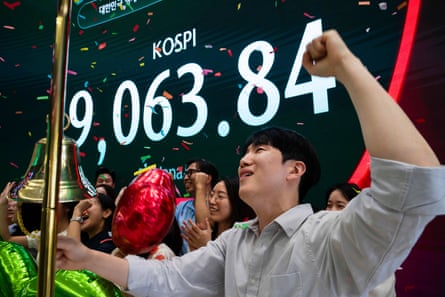 Workers celebrate as a display shows South Korea’s KOSPI index at an all-time high closing price of 9,063.84. Photograph: Jintak Han/ZUMA Press Wire/Shutterstock
theguardian.com
Workers celebrate as a display shows South Korea’s KOSPI index at an all-time high closing price of 9,063.84. Photograph: Jintak Han/ZUMA Press Wire/Shutterstock
theguardian.com
 South Korean president Lee Jae-myung holds hands with Samsung Electronics Chairman Lee Jae-yong, right, and SK Group Chairman Chey Tae-won as they announced a new computer chipmaking hub on Monday. Photograph: Kim Min-Hee/Pool KYODONEWS/AP
theguardian.com
South Korean president Lee Jae-myung holds hands with Samsung Electronics Chairman Lee Jae-yong, right, and SK Group Chairman Chey Tae-won as they announced a new computer chipmaking hub on Monday. Photograph: Kim Min-Hee/Pool KYODONEWS/AP
theguardian.com
South Korea’s AI chip boom is generating windfall bonuses for a narrow slice of workers and investors, while leaving most households watching the gains from the sidelines. The Guardian reports that memory-chip staff at Samsung Electronics have received unusually large payouts—some close to 600 million won on an 80 million won base salary—while SK Hynix paid bonuses amounting to nearly 3,000% of monthly salary earlier this year.
The boom is concentrated because the product is concentrated. South Korea’s surge is being driven largely by Samsung and SK Hynix, which dominate global supply of high-bandwidth memory used in AI systems, according to The Guardian. Analysts project that the pair’s combined operating profits could rise nearly sevenfold in the current year, a forecast that has helped push the Kospi to record highs. For policymakers, it is a familiar dilemma: a strategic industry delivers export earnings and national prestige, but the cash distribution follows ownership and bargaining power, not the flag.
Spillovers show up first in consumption patterns that are easy to count. The Guardian describes luxury sales rising in satellite cities near chip factories south of Seoul, including sharp increases in jewellery and watch sales at a department store, and a jump in imported car registrations in Icheon, home to SK Hynix’s main campus. Housing markets are responding too: apartments near semiconductor company bus routes are reportedly rising at multiples of wider Seoul-area rates. The wealth is not just higher incomes; it is proximity to a payroll and a commute.
Some of the gains are accessible only through capital markets, which rewards those who already have spare money and patience. The Guardian profiles a Seoul retiree who bought small amounts of SK Hynix and Samsung shares years ago and says he has seen a more than tenfold return on SK Hynix. For workers outside the chip giants and for small firms, the comparison is harsher: The Guardian reports that the average annual salary at a small South Korean company is about one seventeenth of a single Samsung memory-chip worker’s bonus.
The tension is now bleeding into social and legal disputes about who owns what, and when. The Guardian notes a high-profile divorce case in Seoul last month that turned on the valuation date of shares linked to the holding company behind SK Hynix, a technical question that could shift the value of a business tycoon’s assets by billions of dollars. When asset prices move faster than wages, the courtroom starts doing some of the country’s accounting.
For now, the boom’s most visible infrastructure is not a new factory or a new lab, but the line of luxury storefronts along the routes where the company buses stop.