
Rare Declaration of Independence printing found in UK National Archives
Volunteer spots Exeter broadside among Royal Navy papers seized in 1776, a founding text survives as mislabelled wartime paperwork
Images
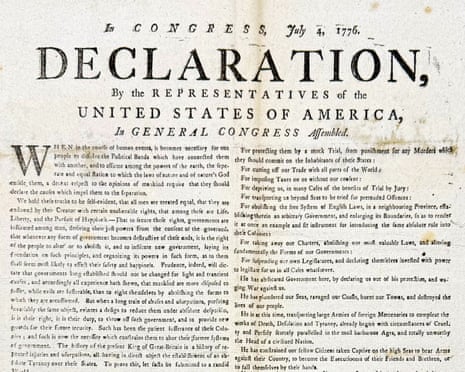 The document was found in a volume of 18th-century Royal Navy correspondence that had not been previously recorded in detail. Photograph: The National Archives
theguardian.com
The document was found in a volume of 18th-century Royal Navy correspondence that had not been previously recorded in detail. Photograph: The National Archives
theguardian.com
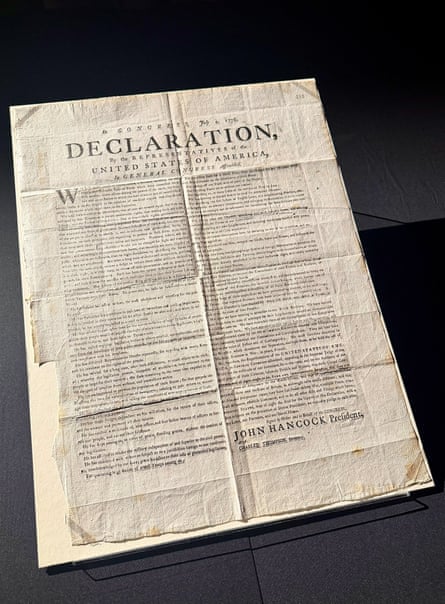 The paper was printed in Exeter, New Hampshire, between 16 and 19 July 1776. Photograph: The National Archives
theguardian.com
The paper was printed in Exeter, New Hampshire, between 16 and 19 July 1776. Photograph: The National Archives
theguardian.com
A volunteer cataloguing 18th-century Royal Navy correspondence at the UK National Archives in Kew found an early printed copy of the US Declaration of Independence that had sat unremarked in naval papers for more than two centuries. The Guardian reports the document is an “Exeter printing”, a broadside produced in New Hampshire in mid-July 1776, with only a small number of surviving copies known.
The paper trail that preserved it is also the one that buried it. According to the Guardian, the document was among papers taken from an American privateer vessel, the Dalton, captured by a British warship off Spain in December 1776. More obviously valuable items were routed into formal legal channels, including a ship’s commission signed by John Hancock that went to the Admiralty Court; the Declaration broadside did not, instead being logged only as “another document” and left inside a volume that had not been described in detail.
That distinction matters because archives are not neutral warehouses; they are shaped by what institutions think is worth indexing. A broadside was built for speed—quick printing, rapid distribution, fast reading—and was never meant to survive as a collectible. Yet the same qualities that made it disposable in 1776 make it legible evidence now: a physical trace of how political news moved along ports and ship decks, not just through official proclamations.
The Guardian notes that the Dalton did not dock in Exeter, suggesting the copy was likely obtained elsewhere in New Hampshire, possibly Portsmouth, by the ship’s captain, Eleazer Johnson. After the capture, Johnson told a court in Plymouth that he was a citizen of the United States—an assertion the British crown treated as treasonous at the time. One National Archives official, Amanda Bevan, speculated that Johnson may have read the Declaration aloud to a crew of about 120 men of mixed nationalities, turning a single sheet of paper into a tool of cohesion and recruitment.
The find also cuts against the tidy national story in which independence documents live only in American repositories. This copy is, according to the Guardian, the only known Exeter printing outside the United States, not because it was gifted or curated, but because it was seized as wartime paperwork and then misfiled. The result is a piece of American political origin preserved by British administrative habit—kept safe not by reverence, but by neglect.
The document was found in late May in Kew, west London, inside a Royal Navy correspondence volume that had been waiting for someone to describe it properly.