
Researchers build synthetic cell that eats grows and divides
University of Minnesota team reports SpudCell life-cycle design built from non-living chemicals, collaboration still depends on flying in to reproduce techniques
Images
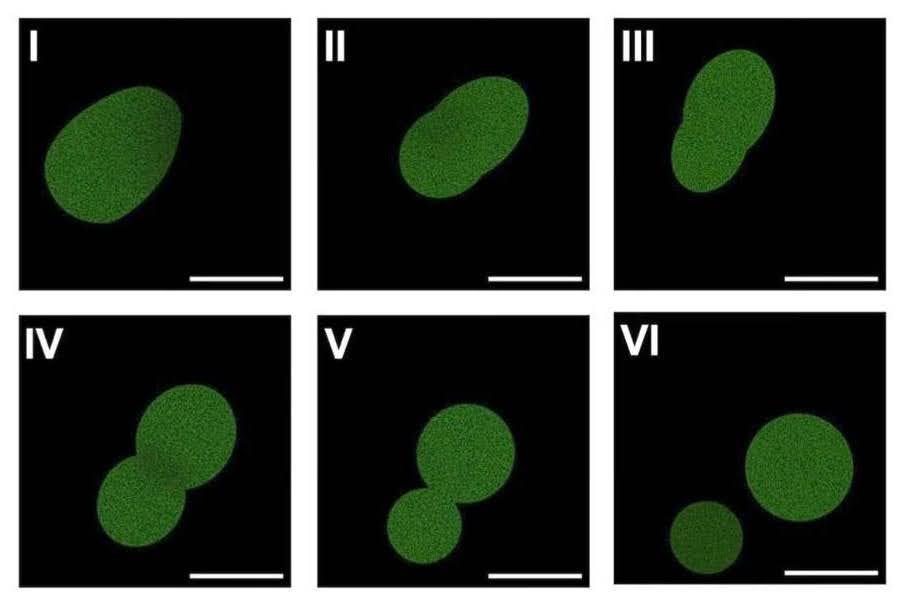 Fluorescent microscopy of SpudCell - a synthetic cell assembled entirely from non-living chemical components - undergoing division (Kate Adamala, Adamala Lab)
Kate Adamala, Adamala Lab
Fluorescent microscopy of SpudCell - a synthetic cell assembled entirely from non-living chemical components - undergoing division (Kate Adamala, Adamala Lab)
Kate Adamala, Adamala Lab
Fluorescent microscopy images show a membrane-bound blob splitting into two, after proteins accumulate on its surface until mechanical stress tears it apart. According to The Independent, researchers at the University of Minnesota say the system—dubbed “SpudCell”—is built entirely from non-living chemical components yet can feed, grow, replicate its genetic material, and divide, completing what they describe as a full life cycle for a synthetic cell.
The team, led by associate professors Kate Adamala and Aaron Engelhart, frames the work as a step toward a standardised “chassis” for engineering cell-like machines. Natural cells rely on a cytoskeleton to coordinate division; SpudCell instead uses a membrane trick, with proteins crowding together until the surface buckles and splits. The researchers report that introducing a genetic change that increased production of a fusion protein produced cells that grew faster and generated more offspring, an attempt to show that selection and iteration—tools of ordinary engineering—can be applied to a cell assembled from scratch.
If that claim holds up across labs, it shifts a long-running debate from “can life be synthesised?” to “who gets to build with it, and under what standards?” The Independent notes that different laboratories still lack shared protocols for what counts as a working synthetic cell, to the point that collaborators flew in for in-person demonstrations to get techniques to work. That bottleneck matters because the promise of synthetic cells is not just academic: the researchers argue that scratch-built cells could perform molecular transformations that industrial chemistry cannot, or that currently require natural cells or energy-intensive, harsh processes.
The project’s modular design is presented as the practical selling point—programming different functions independently rather than treating the cell as an indivisible black box. But the same article also lists the unfinished plumbing: SpudCell’s seven DNA plasmids still need to be consolidated into a single, more stable genome, and additional molecular machinery remains to be built. In the near term, that leaves a familiar pattern in biotech: a striking demonstration, a long checklist of engineering work, and a race to define interfaces before the field fragments into incompatible toolchains.
The researchers are also trying to solve the coordination problem explicitly. The Independent describes an effort called Biotic, intended to focus engineering work and make it compatible with a shared chassis, with SpudCell positioned as that baseline. In practice, the first standards in a new platform tend to be set by whoever can supply the reference design and the protocols to reproduce it, not by whoever writes the most ambitious roadmap.
For now, the most concrete fact is that the system divides without a cytoskeleton, by crowding proteins on a membrane until it breaks.