
George Monbiot: UK heatwave warnings become culture-war target
Telegraph Sun and Daily Mail invoke 1976 to oppose closures, surveys show many people do not know how to cope with extreme heat
Images
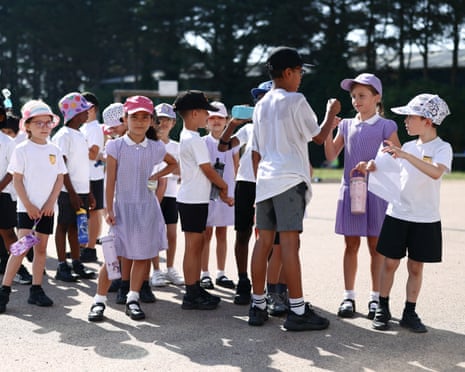 Pupils at the Harris academy primary Mayflower in Grays, Essex, during last week’s heatwave. Photograph: Jack Taylor/Reuters
theguardian.com
Pupils at the Harris academy primary Mayflower in Grays, Essex, during last week’s heatwave. Photograph: Jack Taylor/Reuters
theguardian.com
 George Monbiot
theguardian.com
George Monbiot
theguardian.com
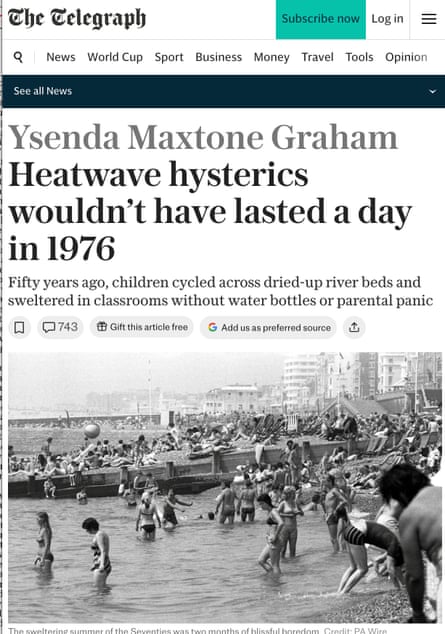 Photograph: The Telegraph
theguardian.com
Photograph: The Telegraph
theguardian.com
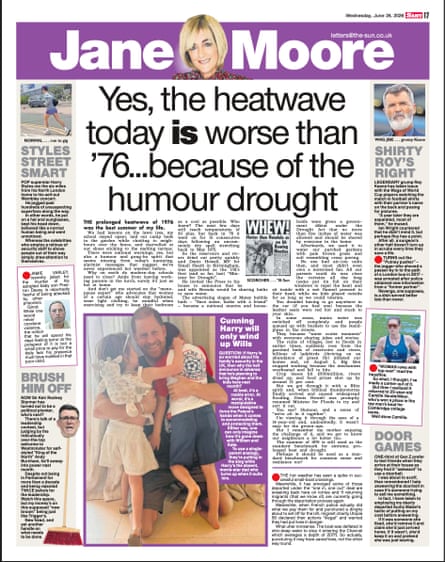 Photograph: The Sun
theguardian.com
Photograph: The Sun
theguardian.com
Pupils at a primary school in Grays, Essex, spent last week trying to learn through a heatwave as parts of the UK argued about whether official warnings were “alarmism”. In a Guardian column, George Monbiot points to a run of right-leaning newspaper commentary—particularly in the Telegraph, the Sun and the Daily Mail—mocking heat-health messaging and school closures, and treating the colour-coded heat maps as an overreaction.
Monbiot’s target is less the weather than the politics of who gets to treat heat as an inconvenience. The Telegraph, he notes, ran an editorial titled “Hot weather alarmism treats the public like children,” complaining that “officialdom” now lectures people at “every opportunity” and should simply trust them to take precautions. A Telegraph columnist, Ysenda Maxtone Graham, is quoted invoking the 1976 heatwave as proof that Britain once managed without “nannying intervention”, describing recent health messages as “patronising” and “preposterous” and recalling children and teachers “swelter[ing] in 30-degree classrooms” without schools closing. Jane Moore in the Sun makes a similar case, arguing schools should stay open and praising 1976 as a benchmark for “common sense”; the Daily Mail, Monbiot writes, has also claimed that schools stayed open then.
The column leans heavily on a practical rebuttal: the 1976 comparison is contested even on its own terms. Monbiot cites Carbon Brief journalist Leo Hickman pointing out that schools did close early during the 1976 heatwave. He also notes that June 1976 did not reach the temperature records set in the recent heatwave, and that the 1976 event was dry while the latest heat came with high humidity—conditions that raise health risks even when headline temperatures look similar.
Underneath the media sparring is a more basic problem: many people do not know what to do when heat becomes dangerous. Monbiot cites a 2023 Red Cross finding of poor understanding of heat-health risks in the UK, and a 2022 survey reported in Energy Research & Social Science in which 49% of participants had little to no knowledge of how to cope with extreme heat. That makes the “trust people to take precautions” line less a theory of freedom than a wager that households already have the information, time and physical conditions to protect themselves.
Heat warnings, in this telling, are not primarily about persuading the confident and well-resourced; they are about reaching those who will not recognise a rising risk until it shows up as a medical emergency. Schools and workplaces sit at the centre of that tension because they concentrate responsibility: when a building is too hot, the person who decides to close it is also the person who will be blamed for disruption, while the costs of staying open are spread across children, staff and health services.
Last week’s classrooms in Grays were real, and the argument about whether to warn people was mostly conducted in print.