
UK economy shrinks in April
Services output falls as Middle East conflict lifts costs, July energy price cap turns geopolitics into household budgeting
Images
 bbc.com
 Getty Images Close-up of a woman holding and reviewing a grocery receipt after shopping.
bbc.com
Getty Images Close-up of a woman holding and reviewing a grocery receipt after shopping.
bbc.com
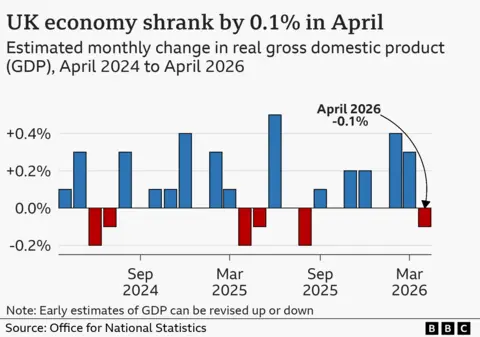 “A bar chart showing the growth of the UK economy. In April 2026, it is estimated to have shrunk by 0.1% , the first time it has shrunk since August 2025 when it contracted by 0.2%.”
bbc.com
“A bar chart showing the growth of the UK economy. In April 2026, it is estimated to have shrunk by 0.1% , the first time it has shrunk since August 2025 when it contracted by 0.2%.”
bbc.com
UK economy shrinks in April as services weaken, ONS links some disruption to Middle East conflict and pricier energy, households brace for higher bills under July price cap
The UK economy contracted by 0.1% in April, according to the Office for National Statistics, with output in services—around three-quarters of the economy—down 0.2%. The BBC reports the monthly fall was the first since August 2025 and came after stronger-than-expected growth in March. The ONS said arts and entertainment, sports activities, and amusement and recreation were among the areas that dragged, with some effects tied to cancellations of sporting events in the Middle East.
The backdrop is a fresh energy shock layered onto an already narrow recovery. Firms told the ONS that the Iran war had pushed up costs and hit turnover, while transport, manufacturing and travel businesses also reported impacts from disruption. The BBC notes the conflict effectively closed the Strait of Hormuz, a key route for oil shipments, sending crude prices sharply higher at one point before easing on hopes of a resolution. Even with oil prices later falling back, the earlier spike has already filtered into UK petrol and diesel prices, and the next step is scheduled: household energy bills are expected to rise in coming months as the energy price cap increases in July.
That sequence matters because it turns a geopolitical event into a domestic budgeting problem. Consumers facing higher fuel and energy costs tend to cut discretionary spending first, which lands directly in the service categories that dominate UK GDP. Businesses, meanwhile, face a squeeze the BBC describes as rising costs paired with subdued demand, limiting how much they can pass on without losing customers. In that environment, a small monthly contraction becomes less about a single data point and more about how quickly confidence can reverse when households start saving in anticipation of larger bills.
The politics is arriving on schedule. Chancellor Rachel Reeves said the Iran war would affect the UK economy, while opposition parties used the figures to argue the government left the country exposed to “geopolitical turmoil,” according to the BBC. Economists cited by the broadcaster expect the Bank of England to keep interest rates unchanged at its mid-June meeting, leaving fiscal choices and energy-price mechanics to do most of the near-term work.
In the three months to April, the economy was still 0.7% larger than in the previous three-month period. But April’s drop was driven by services—the part of the economy that reacts first when households start treating the next utility bill as the main number that matters.