
Raids expose sexual abuse inside southeast Asia scam compounds
Guardian reports women trafficked into Laos Myanmar and Cambodia to run pig-butchering schemes, online fraud scales because captivity is cheap
Images
 Hundreds of thousands of people have been trafficked into the Golden Triangle’s scam compounds, where day-to-day life consists of forced labour, cramped living conditions and beatings. For women, there is the additional trauma of sexual abuse. Illustration: Masha Foya/The Guardian
theguardian.com
Hundreds of thousands of people have been trafficked into the Golden Triangle’s scam compounds, where day-to-day life consists of forced labour, cramped living conditions and beatings. For women, there is the additional trauma of sexual abuse. Illustration: Masha Foya/The Guardian
theguardian.com
 Offices at Shunda Park, a cyberscam compound in Myanmar captured by Karen rebels from the junta-allied militia guarding the complex. Photograph: Jes Aznar/NYT/Redux/eyevine
theguardian.com
Offices at Shunda Park, a cyberscam compound in Myanmar captured by Karen rebels from the junta-allied militia guarding the complex. Photograph: Jes Aznar/NYT/Redux/eyevine
theguardian.com
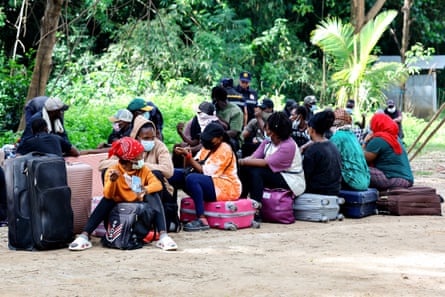 Trafficking victims from various countries, who worked in the KK Park cyberscam compound, sit with their belongings after crossing the Thai border. Photograph: Thai News Pix/AFP/Getty
theguardian.com
Trafficking victims from various countries, who worked in the KK Park cyberscam compound, sit with their belongings after crossing the Thai border. Photograph: Thai News Pix/AFP/Getty
theguardian.com
 Photographs and props used to create fake online personas to lure cyberscam victims found at Shunda Park. Photograph: Jes Aznar/NYT/Redux/eyevine
theguardian.com
Photographs and props used to create fake online personas to lure cyberscam victims found at Shunda Park. Photograph: Jes Aznar/NYT/Redux/eyevine
theguardian.com
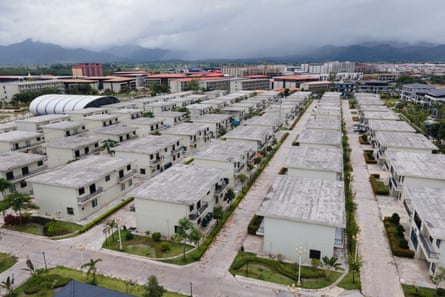 Accommodation at KK Park, one of the major cyberscam centres. Like many of the compounds, it had armed guards, watchtowers and checkpoints. Photograph: Jittrapon Kaicome/The Guardian
theguardian.com
Accommodation at KK Park, one of the major cyberscam centres. Like many of the compounds, it had armed guards, watchtowers and checkpoints. Photograph: Jittrapon Kaicome/The Guardian
theguardian.com
Hundreds of thousands of people have been trafficked into scam compounds across parts of mainland south-east Asia, according to The Guardian, as raids and survivor testimony fill in what the industry looks like behind the screens. The reporting describes compounds in the Golden Triangle region and elsewhere in Laos, Myanmar and Cambodia where workers are held in cramped conditions, beaten, and forced to run online scams through long night shifts. In one case recounted by The Guardian, a woman trafficked into Laos escaped during labour after using a shared smartphone to contact a taxi driver and reach a hospital.
The mechanics of the business are familiar to anyone who has watched the “pig-butchering” scam spread through Western social media: fake profiles on platforms such as Facebook and Instagram, scripted conversations monitored by supervisors, and a slow funnel into fraudulent cryptocurrency “investments” illustrated with fabricated profit screenshots. What the raids reveal is not just that the scams are industrialised, but that the labour supply is coerced at scale. The Guardian reports that tens of thousands of people have been freed in raids, suggesting a churn where compounds can lose workers and still reopen, recruit and expand. Survivors describe being sold between sites, a detail that makes the compounds look less like isolated criminal dens and more like a regional market in captives.
Women’s accounts add another layer: sexual violence used as punishment and control inside facilities previously assumed to hold mostly men. The Guardian describes “dark rooms” where women were assaulted after refusing to meet scamming targets, and reports of group rape as a disciplinary tool. The alleged operators are described as Chinese and Taiwanese criminal syndicates, a cross-border structure that complicates enforcement: the compounds sit in jurisdictions with uneven state capacity and, in some areas, armed actors with their own revenue needs. When the product is digital and the victims are overseas, the local costs of tolerating the industry are easier to ignore—until trafficking victims start crossing borders in large numbers and raids become a diplomatic necessity.
The scams themselves depend on the same platforms that make identity cheap and verification optional, while the physical compounds depend on a different kind of infrastructure: guarded buildings, compliant local authorities, and a steady inflow of people promised legitimate work. Each raid that frees captives also advertises that the compounds exist, which can push syndicates to move locations rather than shut down. The result is a crime economy that behaves like a mobile factory network, with victims as both the workforce and, eventually, evidence.
The Guardian’s story includes images of offices inside named compounds and of trafficking victims crossing the Thai border. The most concrete detail is also the simplest: the scams run on smartphones and scripts, but the business is enforced with locked doors and beatings.