
Five killed in shooting at youth welfare facility in Stade
Police detain two at scene near Hamburg, supervised accommodation becomes a crime scene before motive is known
Images
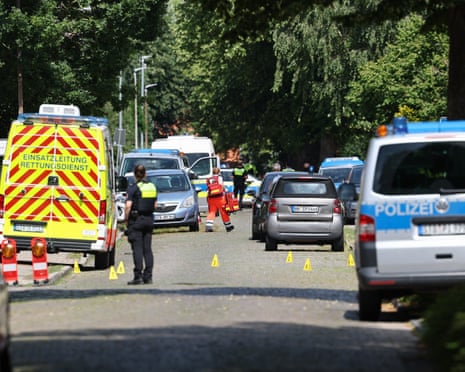 Police and rescuers work at the scene where five people were killed in a shooting in Stade, northern Germany. Photograph: Ibrahim Ot/AFP/Getty Images
theguardian.com
Police and rescuers work at the scene where five people were killed in a shooting in Stade, northern Germany. Photograph: Ibrahim Ot/AFP/Getty Images
theguardian.com
Five people were killed in a shooting at a youth welfare facility in Stade near Hamburg on Sunday, according to the Guardian’s Europe live blog citing German police. Two people were apprehended at the scene, including the suspected shooter, and police said there was no ongoing danger to the public. The facility includes supported accommodation for young mothers, and an unspecified number of people were reported injured.
The limited information released in the first hours already points to a familiar pattern in Europe’s public institutions: when violence erupts inside a state-funded care setting, the immediate response is containment and reassurance, while the harder questions are deferred. Police offered no clear motive, and early messaging emphasised the absence of a continuing threat rather than explaining how a lethal attack unfolded in a place designed for supervision and safeguarding. That gap matters because youth welfare facilities sit at the end of long administrative chains — family courts, social services, contracted care providers, and local authorities — where responsibility is distributed and failures are often procedural rather than dramatic.
The sector has expanded across Europe as governments have shifted more social risk into managed accommodation: young people without stable families, minors in care, and young parents needing support are placed into structures that combine housing with oversight. These sites are meant to reduce harm, but they also concentrate vulnerable residents, staff, and visitors in predictable locations. When security is treated as an afterthought — something handled by calling police once a crisis begins — institutions end up relying on perimeter control and press statements rather than prevention.
The early framing of the Stade attack as potentially having a “private” motive, as reported by the Guardian, also illustrates how quickly authorities try to narrow public interpretation before facts are established. In practice, “private” can cover everything from domestic disputes to conflicts involving residents, staff, or outsiders with access to the premises. Without details on how the suspect entered, what supervision was in place, or how residents were protected, the public is left with a simple headline and a closed-off scene.
By Sunday night, the concrete facts remained few: a youth welfare facility in Stade, five dead, injuries not yet quantified, and two people in custody. The rest of the story — how a supervised home became a crime scene — will depend on what investigators choose to release after the cordons come down.