
Venezuela earthquake death toll rises above 1450
Rescue teams arrive five days after twin quakes, shortage of heavy machinery turns survival into logistics
Images
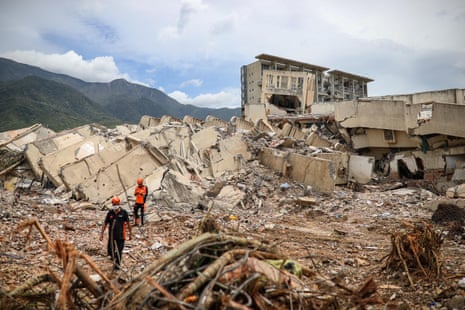 Search and rescue operations continue for survivors trapped under collapsed buildings in the coastal state of La Guaira on 28 June, 2026. Photograph: Cem Tekkesinoglu/Anadolu via Getty Images
theguardian.com
Search and rescue operations continue for survivors trapped under collapsed buildings in the coastal state of La Guaira on 28 June, 2026. Photograph: Cem Tekkesinoglu/Anadolu via Getty Images
theguardian.com
At least 1,450 people have been reported dead after two powerful earthquakes struck Venezuela within a minute of each other, according to a live update from the Guardian. Five days on, the country’s National Assembly president Jorge Rodríguez warned on television that the window to find survivors is closing, as additional search-and-rescue teams arrive and families continue reporting missing relatives.
The numbers in the update sketch a disaster that quickly outgrew the state’s ability to respond. The Guardian reports at least 3,150 injured and roughly 12,721 displaced, alongside a far larger figure: nearly 68,900 people reported unaccounted for by relatives. Officials said power had been restored in La Guaira, the badly hit coastal state near the country’s main international airport, but rescue work has been constrained by a shortage of heavy machinery and insufficient manpower. The government, the report says, is relying on international aid.
In most earthquakes, the first 72 hours determine who lives and who does not; after that, rescue efforts often shift toward recovery. Venezuela’s timeline described in the update—teams arriving days after the quake—puts that reality in tension with official broadcasts urging urgency. A state that must import both equipment and capacity also imports the politics that come with it: foreign help arrives with its own logistics, priorities, and public messaging, while domestic authorities retain control over access, security, and the information flow.
La Guaira’s importance adds another layer. It is a port area close to the main international airport, meaning it is both a lifeline for incoming assistance and a bottleneck that can slow it. When heavy machinery is scarce, decisions about where to deploy it become the real policy, even if they are framed as technical triage. Meanwhile, a large pool of missing persons reports can reflect genuine mass displacement and communications breakdowns, but it also shows how quickly families are left to build their own accounting systems when official registries and emergency coordination fall behind.
As the Guardian’s update put it, these are “critical hours” for survivors still trapped under collapsed buildings. Five days after the tremors, the most consequential resources are not speeches or statements but excavators, fuel, and crews who can work continuously without stopping to negotiate permissions.
In La Guaira, electricity is reported back on. The heavy machinery needed to clear rubble is still described as in short supply.