
AI bubble warnings fail to slow US stocks
Market gains concentrate in Magnificent Seven, debt-funded buildout keeps investors locked in
Images
 Stock markets continue on their upward trend despite warnings of an AI bubble. Photograph: Christian Ohde/Alamy
theguardian.com
Stock markets continue on their upward trend despite warnings of an AI bubble. Photograph: Christian Ohde/Alamy
theguardian.com
 Phillip Inman
theguardian.com
Phillip Inman
theguardian.com
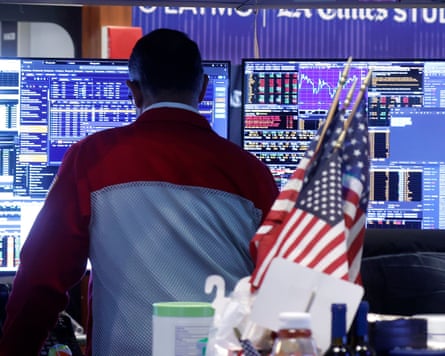 Fears of a tech-driven crash continue to haunt the S&P 500. Photograph: John Angelillo/UPI/Shutterstock
theguardian.com
Fears of a tech-driven crash continue to haunt the S&P 500. Photograph: John Angelillo/UPI/Shutterstock
theguardian.com
 Meta is unlikely to sell more ads sufficient to justify its share price. Photograph: Samuel Boivin/NurPhoto/Shutterstock
Shutterstock
Meta is unlikely to sell more ads sufficient to justify its share price. Photograph: Samuel Boivin/NurPhoto/Shutterstock
Shutterstock
Stock markets are still rising as warnings about an artificial-intelligence bubble get louder, according to The Guardian. The debate is concentrated in New York, where the S&P 500 and Nasdaq have continued to push higher even after repeated cautions that AI-related valuations have run ahead of underlying profits.
The Guardian describes a market increasingly dominated by a small cluster of companies—Amazon, Alphabet, Nvidia, Meta, Microsoft, Apple and Tesla—whose share-price momentum has become a stand-in for “the market” itself. That concentration matters because it changes how risk travels: when gains are narrowly sourced, broad index performance can mask weakening confidence elsewhere, and portfolio managers who underweight the leaders risk falling behind peers even if they doubt the story. The article points to a familiar pattern: investors who warn early are often punished socially and financially while prices keep rising, which hardens the market against cautionary voices and turns “fear of missing out” into a stabilising force.
The AI boom also has a balance-sheet shape. The Guardian notes that investor appetite wobbled earlier in the year as several of the biggest companies began borrowing to fund AI investments, a reminder that much of the buildout is being financed up front while payoffs remain uncertain. That dynamic makes the cycle less about one breakthrough product and more about fixed commitments—data centres, chips, long-term contracts and debt—that cannot be easily unwound if revenue disappoints. In that environment, the “bubble” question becomes less about whether AI is useful and more about whether today’s prices assume a speed and scale of monetisation that advertisers, consumers and enterprise budgets may not deliver.
Geopolitics has not broken the spell. The Guardian writes that markets dipped after Donald Trump “fired rockets in Iran’s direction” before recovering quickly, and then surged again when Trump later said he was in talks with Iran. The implication is not that diplomacy or conflict is irrelevant, but that large pools of capital now treat shocks as temporary interruptions to a trade they feel compelled to stay in.
Some prominent investors are trying to put timestamps on the risk. The Guardian cites Allianz chief investment officer Ludovic Subran pointing to SpaceX borrowing via a large bond sale soon after a major listing as a sign of “bubble territory,” while veteran investor Jeremy Grantham says he is selling because he expects the AI bubble to burst. The article also quotes BCA Research strategist Dhaval Joshi describing the moment as “the madness of crowds,” and argues that Meta may struggle to sell enough advertising to justify its share price.
For now, the market’s main discipline appears to be relative performance: the cost of being wrong with the crowd is smaller than the cost of being right too early. Last week, despite another round of warnings, the indexes kept climbing.