
Dan Jarvis reopens UK defence investment plan
Healey quit over funding gap and Treasury resistance, tanker seizure video lands as budgets are cut elsewhere
Images
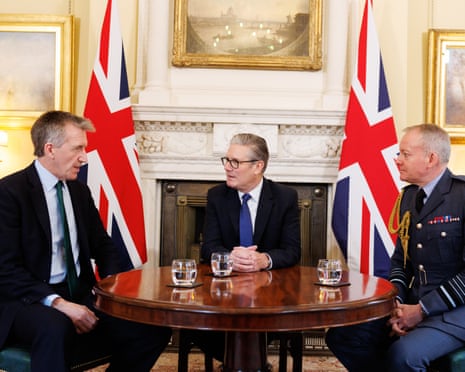 Dan Jarvis (left) with Keir Starmer and the chief of defence staff, Sir Richard Knighton, at No 10. Photograph: Simon Dawson/No 10 Downing Street
theguardian.com
Dan Jarvis (left) with Keir Starmer and the chief of defence staff, Sir Richard Knighton, at No 10. Photograph: Simon Dawson/No 10 Downing Street
theguardian.com
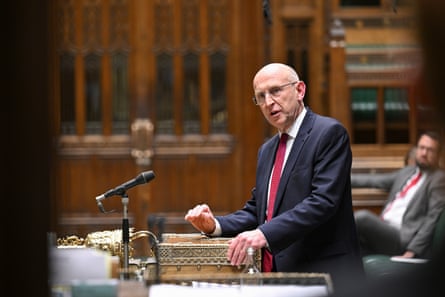 John Healey resigned as the defence secretary on Thursday over funding of the country’s armed forces. Photograph: House of Commons
theguardian.com
John Healey resigned as the defence secretary on Thursday over funding of the country’s armed forces. Photograph: House of Commons
theguardian.com
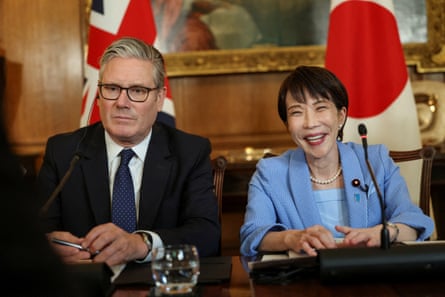 Keir Starmer and Japan’s prime minister, Sanae Takaichi, met at Downing Street on Sunday with a joint fighter-jet project said to be under discussion. Photograph: Toby Shepheard/Reuters
theguardian.com
Keir Starmer and Japan’s prime minister, Sanae Takaichi, met at Downing Street on Sunday with a joint fighter-jet project said to be under discussion. Photograph: Toby Shepheard/Reuters
theguardian.com
A funding gap that ministers argued about in private has now produced a public resignation and a new defence secretary. Dan Jarvis is expected to revisit the UK’s delayed defence investment plan, according to The Guardian, after his predecessor John Healey quit over what he said was insufficient money for the armed forces.
Healey’s departure left the investment plan pushed back to July, just as Prime Minister Keir Starmer heads into the G7 with Russia and Iran on the agenda. The dispute is not over whether threats are rising, but over which parts of government must pay for the response. The Guardian reports Healey said Downing Street offered £13.5bn to cover an £18bn gap in major defence projects, with the remainder to be found partly by cutting other departments’ capital budgets by 1%.
Jarvis’s allies are briefing that he will “reprioritise” the plan rather than demand new money. That language matters because it tells the services what kind of argument they are about to lose: not “defence versus the Treasury”, but “one weapons programme versus another”. According to The Guardian, Starmer and chancellor Rachel Reeves had already pressed Healey to shift spending toward autonomous ships and drones, a choice that tends to create winners among newer suppliers and losers among established platforms with long delivery tails.
The political problem is that the government has made promises in percentage terms while the budget is being fought in cash terms. Sources close to Healey told The Guardian that tweaks miss the core issue: a credible route to higher spending as a share of GDP, including discussion of a Nato target of 3.5% by 2035. But cabinet ministers are also described as reluctant to reopen their own settlements, with “red lines” around capital projects. In that environment, the defence secretary can cut projects, but cannot easily cut the expectations attached to them.
Even as the investment plan stalls, the government is advertising operational assertiveness. The Guardian notes that Royal Marines seized a Russia-linked “shadow fleet” oil tanker in the English Channel in an operation the Ministry of Defence said had been planned months in advance; Starmer posted a video of the capture with the caption “Another bad day to be Vladimir Putin.” The choreography puts a high-visibility enforcement action next to a low-visibility budgeting fight, and invites the question of which one is easier to sustain.
Jarvis is expected to return to the investment plan in July. Healey left behind a number—an £18bn gap—that still has to be closed on paper before it can be closed in steel.