
Israeli strike hits Beirut Dahiyeh
Trump urges Israel and Hezbollah to stand down as US Iran deal nears, negotiators try to write a regional ceasefire around actors not at the table
Images
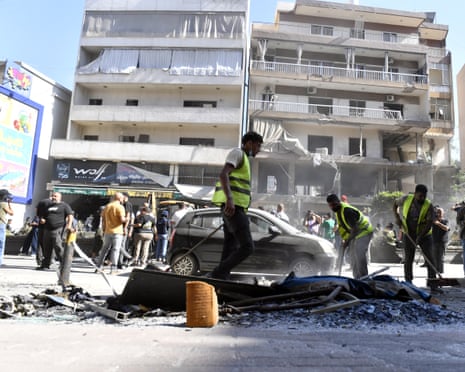 An Israeli airstrike on the Dahiyeh district of Beirut on Sunday killed three people. Photograph: Houssam Shbaro/Anadolu/Getty Images
theguardian.com
An Israeli airstrike on the Dahiyeh district of Beirut on Sunday killed three people. Photograph: Houssam Shbaro/Anadolu/Getty Images
theguardian.com
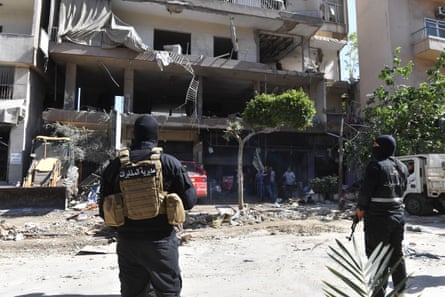 Members of security forces gather near a heavily damaged building after an Israeli airstrike on the Dahiyeh district in Beirut on Sunday. Photograph: Houssam Shbaro/Anadolu/Getty Images
theguardian.com
Members of security forces gather near a heavily damaged building after an Israeli airstrike on the Dahiyeh district in Beirut on Sunday. Photograph: Houssam Shbaro/Anadolu/Getty Images
theguardian.com
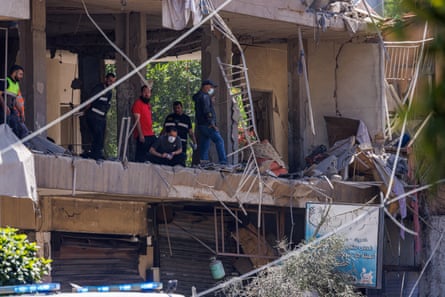 Police officers and emergency personnel work at the site of an Israeli strike on the southern suburbs of Beirut on Sunday. Photograph: Zohra Bensemra/Reuters
theguardian.com
Police officers and emergency personnel work at the site of an Israeli strike on the southern suburbs of Beirut on Sunday. Photograph: Zohra Bensemra/Reuters
theguardian.com
Three people were killed and six injured when an Israeli airstrike hit Beirut’s Dahiyeh district on Sunday, destroying a building in the Hezbollah stronghold, according to The Guardian. The attack came as US and Iranian officials and regional mediators were trying to close a preliminary memorandum intended to end a three-month war that has repeatedly spilled across borders.
Donald Trump responded publicly, urging all sides to stand down and warning Israel not to jeopardise a deal he has portrayed as close. According to The Guardian, Trump said the strike delayed the signing “by a few hours” and told Axios he had spoken to Israeli prime minister Benjamin Netanyahu. Israel said it targeted senior Hezbollah commanders after Hezbollah launched three projectiles toward northern Israel, framing the incident as a ceasefire breach rather than a new front.
The timing matters because the draft understanding being discussed is not only about Iran and the US. Tehran has insisted that any wider agreement must cover “all fronts”, including Lebanon, where Israel has launched a broad offensive and occupies parts of the south, The Guardian reports. That demand pushes a problem of enforcement onto governments that do not fully control the armed groups operating in their territory: Lebanon was not negotiating on Hezbollah’s behalf, and Hezbollah has its own chain of command and incentives.
Iranian officials used the Beirut strike to question Washington’s ability to deliver on commitments. The Guardian cites Mohammad‑Bagher Ghalibaf, Iran’s parliamentary speaker and a lead negotiator, warning that Israel’s actions showed America either lacked the will or the ability to keep its side of any bargain. Iran’s military messaging also tightened; Gen Mohammad Jafar Asadi said the strike would not go unanswered, according to Iran’s Mizan news agency.
Regional mediators were still working the file. The Guardian reports that Qatari mediators travelled to Tehran on Sunday to finalise terms of a memorandum expected to be signed electronically, with unconfirmed reports that Iran would reopen shipping through the Strait of Hormuz in exchange for US steps to lift its blockade and allow oil sales. Before the war, the strait carried a large share of global oil and liquefied gas flows; in this negotiation it functions less as a geographic chokepoint than as a bargaining chip that can be turned on and off.
A peace text can be agreed on paper while the war continues in practice. In Dahiyeh, the concrete result was a destroyed building and bodies pulled from rubble, while diplomats argued over sequencing and guarantees.
On Sunday evening, the preliminary agreement Trump had suggested could be signed that day still had not been concluded, and Beirut’s southern suburbs had another fresh crater.