
Swiss voters reject population cap referendum
Swiss People’s Party plan threatened free movement deal with EU, growth pressures stay while the legal trigger is removed
Images
 In the run-up to the poll, opinions on the likely outcome were divided
bbc.com
In the run-up to the poll, opinions on the likely outcome were divided
bbc.com
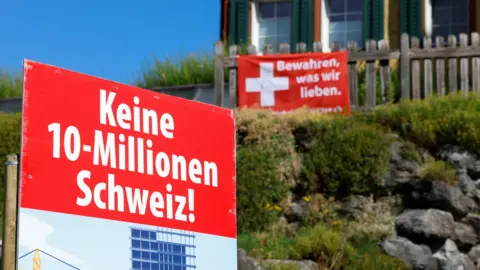 In the run-up to the poll, opinions on the likely outcome were divided
bbc.com
In the run-up to the poll, opinions on the likely outcome were divided
bbc.com
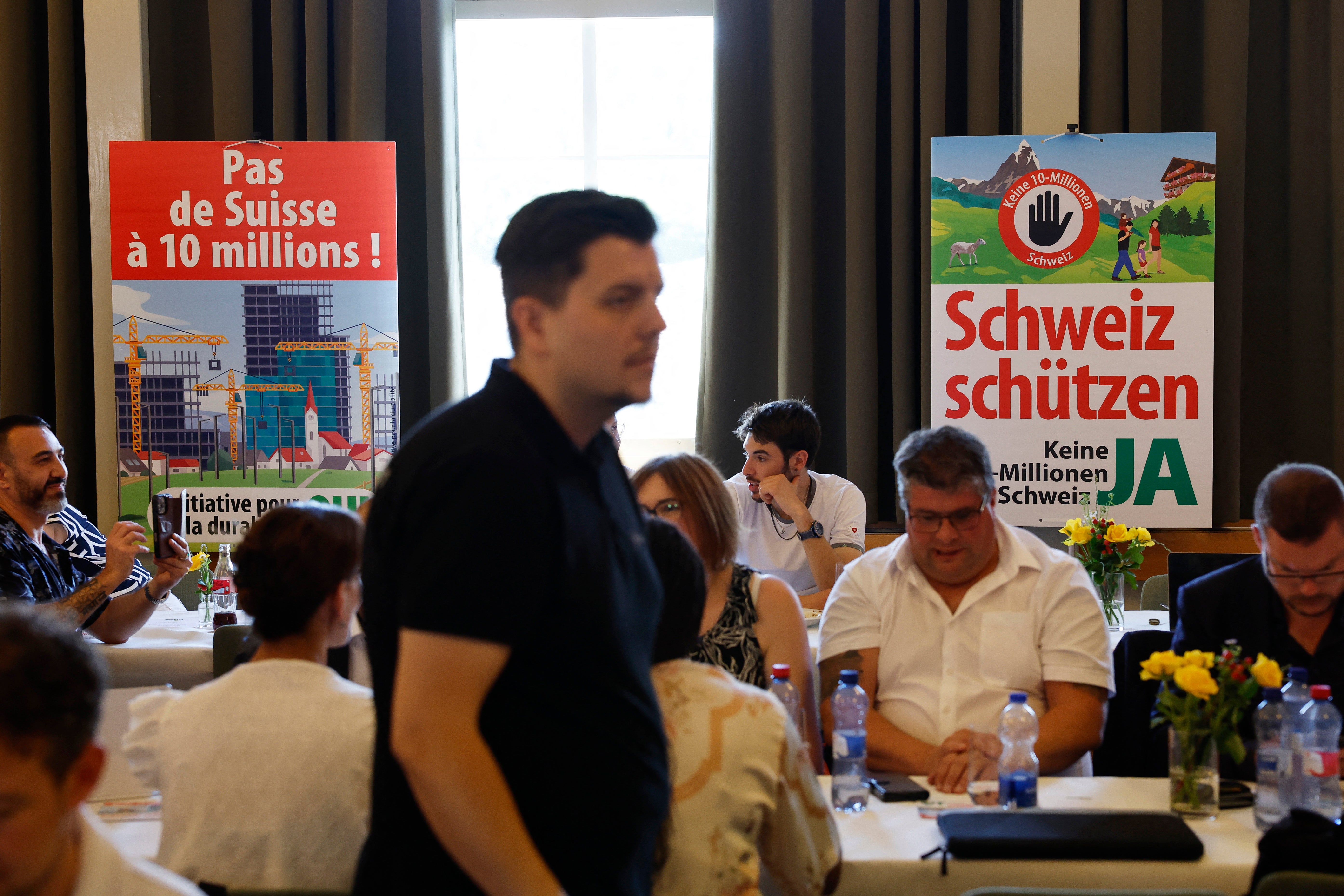 A man walks past election placards reading "Not a 10-million Switzerland" (L) and "Protect Switzerland" (AFP/Getty)
AFP/Getty
A man walks past election placards reading "Not a 10-million Switzerland" (L) and "Protect Switzerland" (AFP/Getty)
AFP/Getty
Swiss voters rejected a proposal to cap the country’s population at 10 million, with early projections showing roughly a 55–45 split as counting continued on Sunday. The initiative, backed by the Swiss People’s Party, would have forced the government to restrict asylum, family reunification and residency permits if the population approached a trigger level, according to the BBC. Because Switzerland’s access to the EU single market is tied to free movement rules, the campaign was also a referendum on whether the country would risk its bilateral arrangements with Brussels.
Switzerland’s population has risen from 7.3 million in 2002 to 9.1 million, and about 27% of residents were born abroad, the BBC reports. The same period has seen economic output grow as well, a fact opponents used to argue that the labour market has absorbed the inflow even as housing, transport and local services have tightened. Supporters framed the cap as a brake on congestion and infrastructure strain; critics warned it would hit sectors that already struggle to recruit, including healthcare and care homes, according to the Independent.
The mechanics of the proposal mattered as much as the headline number. A ‘yes’ vote would not have stopped growth immediately; it would have written a deadline and a set of automatic restrictions into policy, with the government obliged to act as the population moved toward the ceiling. That kind of trigger turns migration into a control knob for problems that are otherwise expensive and slow to fix—housing supply, transport capacity, school expansion—while leaving voters to discover later which permits get cut first and which industries get exemptions.
Business groups focused on the cost of losing EU market access: more than half of Swiss products are sold into the EU, and the bilateral framework depends on free movement. The campaign therefore put two constituencies in direct conflict: employers who want predictable access to workers and voters who experience the pressure in rents, commuting and public services. Switzerland has run similar arguments through the ballot box for decades, but only one immigration-related referendum has narrowly passed in recent years, the Independent notes.
The country’s direct-democracy system makes these tensions unusually legible. A party can gather signatures, force a nationwide vote, and put the government on the hook for implementing a broad mandate whose details are negotiated later.
On Sunday, the electorate chose not to hard-code a population ceiling into that system. Switzerland still ends the weekend with 9.1 million residents and a free-movement agreement that remains intact—for now.