
Thailand holds royal procession for Princess Bajrakitiyabha
Mourners line Bangkok streets after her death following prolonged coma, state ritual turns traffic control into televised continuity
Images
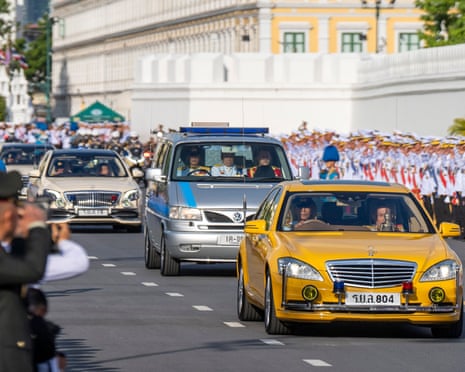 The procession transports the princess’s body to the Grand Palace in Bangkok. Photograph: Adryel Talamantes/Zuma Press Wire/Shutterstock
theguardian.com
The procession transports the princess’s body to the Grand Palace in Bangkok. Photograph: Adryel Talamantes/Zuma Press Wire/Shutterstock
theguardian.com
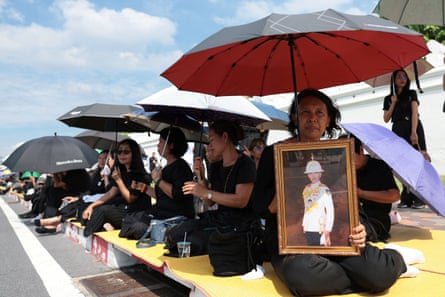 Mourners near the Grand Palace wait for the procession. Photograph: Chalinee Thirasupa/Reuters
theguardian.com
Mourners near the Grand Palace wait for the procession. Photograph: Chalinee Thirasupa/Reuters
theguardian.com
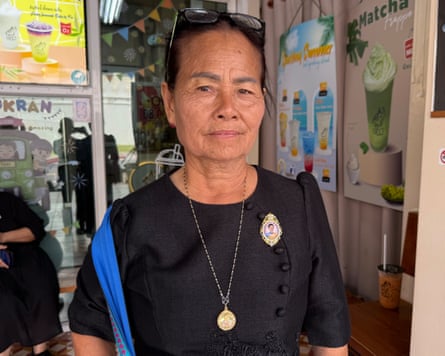 Wanida Lainun. Photograph: Natasha May/The Guardian
theguardian.com
Wanida Lainun. Photograph: Natasha May/The Guardian
theguardian.com
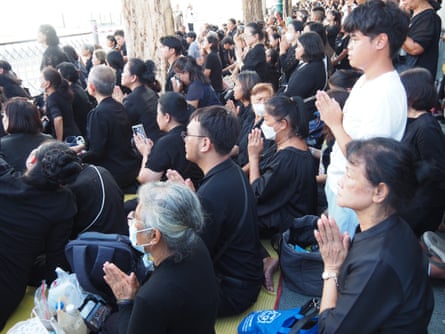 Mourners pay respects as the procession passes by. Photograph: Natasha May/The Guardian
theguardian.com
Mourners pay respects as the procession passes by. Photograph: Natasha May/The Guardian
theguardian.com
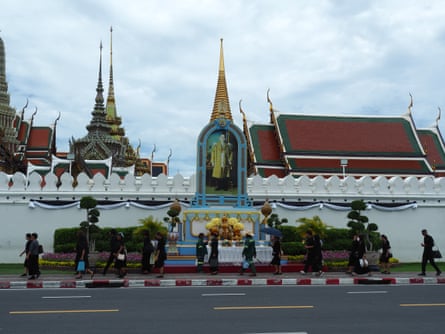 Mourners walk to the Grand Palace for the funeral bathing ceremony. Photograph: Natasha May/The Guardian
theguardian.com
Mourners walk to the Grand Palace for the funeral bathing ceremony. Photograph: Natasha May/The Guardian
theguardian.com
Thailand’s Princess Bajrakitiyabha was carried in a royal funeral procession from hospital through central Bangkok to the Grand Palace on Saturday, after dying earlier in the week following a prolonged coma, the Guardian reports. Streets were closed to traffic as thousands of mourners dressed in black lined the route, while officials in white uniforms saluted and nurses bowed prostrate. Her father, King Maha Vajiralongkorn, followed behind the silver van carrying her body.
Bajrakitiyabha had been in hospital since December 2022 after collapsing while training her dogs, according to the Guardian. The paper describes mourners waiting since morning in hot, humid weather, holding umbrellas and fans, and later taking part in a funeral bathing ceremony at the Grand Palace as rites began. In a country where the monarchy remains a central institution, public ritual still doubles as a demonstration of administrative capacity: road closures, coordinated uniforms, controlled crowds, and a single official image broadcast outward.
The princess’s public profile also explains the scale of the choreography. The Guardian notes she trained as a lawyer and served in official roles, including as ambassador to Austria and within the royal security command. She was also associated with projects framed as public service—campaigning for the rights of female prisoners and supporting disaster relief—giving supporters concrete stories to tell on the street. One mourner cited a project helping underprivileged people in Chiang Mai; another recalled flood relief work in the 1990s, including the Friends in Need (of ‘Pa’) initiative under the Thai Red Cross Society.
Royal mourning in Thailand is never only personal. The state can ask for visible participation—black clothing, time spent waiting in the heat—because the costs are dispersed across millions of people, while the benefits of a unified spectacle accrue to the institution. At the same time, the ritual offers an outlet for genuine grief that is hard to separate from civic obligation; the Guardian describes silent bowing, tears, and a crowd that did not need prompting once the motorcade arrived.
The procession also underlines an unresolved practical question: succession and continuity are managed in public long before they are debated in law. The princess, widely known as “Princess Bha”, was a recognisable working royal with a portfolio that reached beyond ceremony into courts, prisons and security. Her absence leaves the institution with one fewer public-facing figure who could plausibly embody modernity without changing the rules.
On Saturday afternoon, Bangkok’s main roads were cleared so a silver van could move from a hospital to the Grand Palace.