
Tommy Robinson detained at Heathrow under counter-terrorism powers
Police seize phones under 2019 port-stop law as Met declines to explain, border questioning becomes a tool for information capture
Images
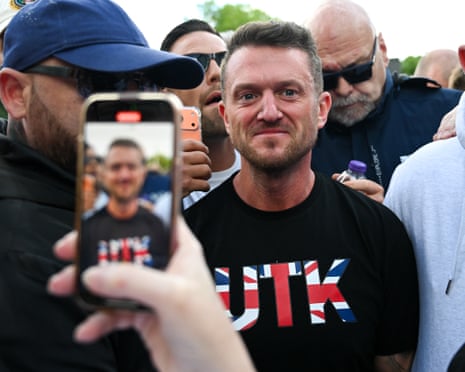 Tommy Robinson, real name Stephen Yaxley-Lennon, with demonstrators protesting over the death of Henry Nowak in Southampton. Photograph: Finnbarr Webster/Getty Images
theguardian.com
Tommy Robinson, real name Stephen Yaxley-Lennon, with demonstrators protesting over the death of Henry Nowak in Southampton. Photograph: Finnbarr Webster/Getty Images
theguardian.com
Tommy Robinson detained at Heathrow under counter-terror powers, police seize phones under port-stop law as authorities decline to say why, a public-order influencer meets an opaque search regime
Police detained the activist known as Tommy Robinson at Heathrow airport on Saturday under counter-terrorism legislation, seizing his phones and questioning him for several hours. The Guardian reports that Robinson, whose real name is Stephen Yaxley-Lennon, was stopped under section 3 of the Counter-Terrorism Border Security Act 2019, which gives officers at ports powers to stop, question, search and detain people suspected of travelling to plan, prepare and carry out hostile acts. The Metropolitan police declined to comment on what the stop related to.
Robinson said on social media that he was detained for almost three hours and that his phones were taken. A spokesperson for him suggested the authorities wanted to see who he was talking to and identify his sources, framing the stop as an attack on free speech and “investigative journalism”, and Robinson asked supporters to donate money for legal costs. The stop comes after a week in which he gained further prominence online, including by amplifying footage from Belfast and posting details of planned demonstrations across Britain and Northern Ireland; Elon Musk shared one of Robinson’s posts to a large audience, according to The Guardian.
The legal tool used is designed for speed and discretion at borders, where the state’s leverage is highest and the subject’s ability to contest the encounter is lowest. In practice, that creates a fog around why a person was stopped and what information was taken, especially when the central objects are phones. Robinson has previously argued that his devices contain confidential journalistic material, and he was cleared of a terror charge after refusing in 2024 to give police access to his phone during a separate stop, when a judge said he could not be sure the earlier stop was lawful.
The contrast between Robinson’s public persona and the law’s broad remit is part of the story. In recent days he has been a node in a fast-moving political feedback loop, where viral clips and protest logistics travel faster than official statements. Port-stop powers, by design, do not require the same public accounting as an arrest following a charged offence; the state gets the search first, and the explanation later, if at all.
At Heathrow, the only concrete outcome disclosed so far is the simplest one: the phones were taken, and the police have not said what they were looking for.