
Lebanese army pulls back from Kfar Tebnit
Israel intensifies strikes and evacuation warnings near Nabatiyeh, a regional ceasefire promise runs into a militia outside the deal
Images
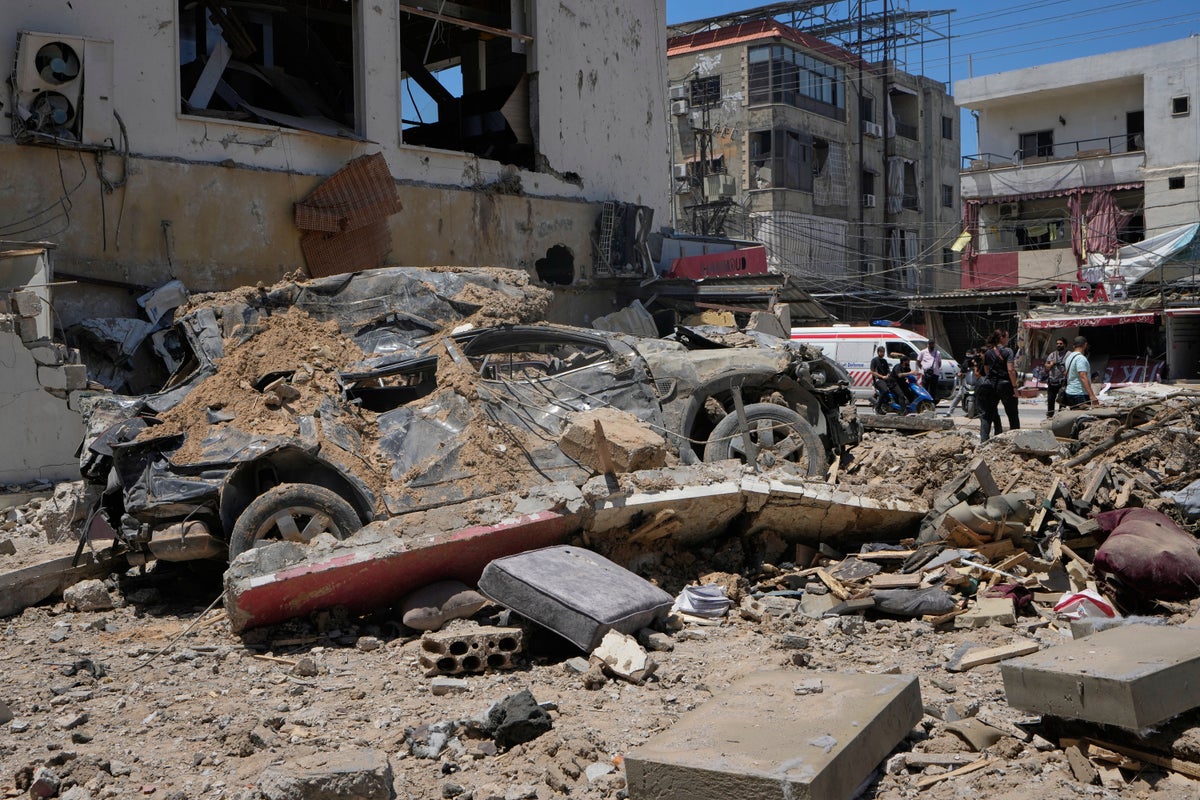 Lebanese army withdraws from southern village after Israeli troops advance nearby
independent.co.uk
Lebanese army withdraws from southern village after Israeli troops advance nearby
independent.co.uk
 Se observa una columna de humo en el sur del Líbano tras una explosión, vista desde el lado israelí de la frontera entre Israel y el Líbano, en el norte de Israel (REUTERS/Ammar Awad)
infobae.com
Se observa una columna de humo en el sur del Líbano tras una explosión, vista desde el lado israelí de la frontera entre Israel y el Líbano, en el norte de Israel (REUTERS/Ammar Awad)
infobae.com
 Las Fuerzas Armadas de Israel atacaron más de 70 infraestructuras pertenecientes al grupo terrorista Hezbollah en el sur del Líbano (Europa Press)
infobae.com
Las Fuerzas Armadas de Israel atacaron más de 70 infraestructuras pertenecientes al grupo terrorista Hezbollah en el sur del Líbano (Europa Press)
infobae.com
 El primer ministro de Pakistán, Shehbaz Sharif (REUTERS/Kylie Cooper)
infobae.com
El primer ministro de Pakistán, Shehbaz Sharif (REUTERS/Kylie Cooper)
infobae.com
More than 70 Israeli strikes hit Hezbollah-linked sites across southern Lebanon over the past day, as the Lebanese army pulled back from a base in Kfar Tebnit after Israeli troops advanced nearby. According to The Independent, Israel also issued evacuation warnings for roughly 20 locations around Nabatiyeh, while Lebanon’s state-run National News Agency reported airstrikes and shelling in the area.
The episode lands in the gap between what diplomats can sign and what armed actors can stop. Pakistani Prime Minister Shehbaz Sharif has said Washington and Tehran have agreed a framework for a peace deal, and Iranian Foreign Minister Abbas Araqchi has described an initial agreement as ending the war “on all fronts”, including Lebanon. Yet Hezbollah is not a party to the Israel–Lebanon ceasefire arrangement that has been renewed repeatedly since April, and Israel has said it will not withdraw from areas it occupies in the south, a position echoed by Israeli officials insisting on freedom to act against threats.
That mismatch matters because Lebanon’s formal institutions are being asked to behave like a state without being allowed to function like one. The Lebanese army, described by The Independent as neutral in the conflict, moved its forces away from the Kfar Tebnit barracks after an Israeli incursion; the same army is expected, in international ceasefire language, to “stabilise” the area while an armed movement outside the chain of command trades rockets and drones with Israel. When the front shifts, it is the national army that relocates first, not the militia.
The tactical geography underlines why the fighting keeps returning to the same ridgelines. The Independent cited a Lebanese military official saying Israeli troops were likely trying to capture the Ali Taher hill overlooking large parts of Nabatiyeh and key connecting roads, a position Israel held for years before withdrawing in 2000. The paper also noted Israel’s capture in late May of a nearby mountain topped by Beaufort Castle, described as the deepest Israeli incursion into Lebanon since 2000.
Casualties and displacement figures have become the background noise to negotiations elsewhere. The Independent reported that Lebanon’s Health Ministry has put deaths in the latest fighting at more than 3,700, while Israel has reported deaths among soldiers and civilians from Hezbollah fire. Infobae, citing an Israeli military statement, said the latest wave of strikes targeted launchers and other infrastructure, and reported additional evacuation orders after projectiles were launched toward Israel and intercepted.
On Saturday, the Lebanese army withdrew from a base in Kfar Tebnit as Israeli troops advanced toward high ground overlooking Nabatiyeh. The same day, mediators were still describing a wider ceasefire as close enough to be signed electronically.