
Yoon Suk Yeol gets 30-year prison sentence
Seoul court finds ex-president sent drones into North Korea, prosecutors say provocation aimed to bolster failed martial law bid
Images
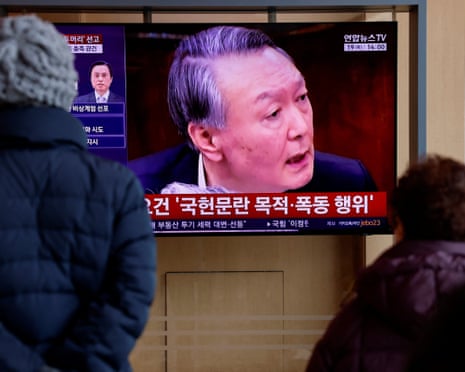 People watch a news report on the sentencing trial of South Korea’s former president Yoon Suk Yeol in February. Photograph: Soo-hyeon Kim/Reuters
theguardian.com
People watch a news report on the sentencing trial of South Korea’s former president Yoon Suk Yeol in February. Photograph: Soo-hyeon Kim/Reuters
theguardian.com
Former South Korean president Yoon Suk Yeol was sentenced to 30 years in prison on Friday for sending drones into North Korea, according to the Guardian citing Reuters and AFP. The Seoul Central District Court found him guilty of abuse of power and aiding the enemy, and confirmed he is already in custody and can appeal.
According to the reporting, prosecutors argued the drone operation was designed to raise tensions with Pyongyang and help create a pretext for Yoon’s failed martial law declaration in 2024. The court said Yoon conspired in the October 2024 incursion from the outset, and special prosecutors have described the episode as an attempt to fabricate wartime conditions that undermined state security. Prosecutors also said the operation risked leaking classified information about South Korean capabilities after drones crashed, turning a covert act into an evidentiary trail.
Yoon has denied wrongdoing, with his lawyers saying he neither ordered nor later approved the drone flights and that they were unrelated to martial law. The defence position, as described by the Guardian, casts the operation as a response to North Korean balloons carrying rubbish across the border, an episode that has periodically spiked public anger in the South. North Korea, for its part, accused Seoul of flying drones over Pyongyang to drop propaganda leaflets three times in October 2024; at the time, South Korea’s defence ministry issued only vague denials and later said it could neither confirm nor deny the allegations.
The sentence lands in a political system that has already pushed Yoon through impeachment, removal by the Constitutional Court, and a snap election won by the liberal President Lee Jae Myung. The Guardian notes the 30-year term adds to a sequence of judgments against Yoon, including an earlier life sentence for leading an insurrection tied to his martial law declaration, which he has appealed. The result is a former head of government litigating his legacy across multiple courts while his successors inherit the security consequences of actions he is accused of taking in secret.
Drone incidents sit in a region where the two Koreas remain technically at war and where signalling often matters as much as damage. Earlier this year, Lee expressed regret after an investigation found officials had sent drones into North Korea in January, and Kim Jong-un’s sister described the statement as wise behaviour—before hopes of rapprochement faded as North Korea resumed calling the South its most hostile enemy. In that context, the court’s finding that a president helped engineer a provocation reframes “deterrence” as a domestic political tool with prison time attached.
The case turns on events from October 2024, but the concrete new fact is the court’s punishment: 30 years, handed down by a central court in Seoul, with an appeal now the only remaining route out of custody.