
E3 ambassadors press Russia for direct Ukraine talks
Rare Moscow meeting follows failed US track and Iran war distraction, Crimea fuel queues show what supply disruption looks like
Images
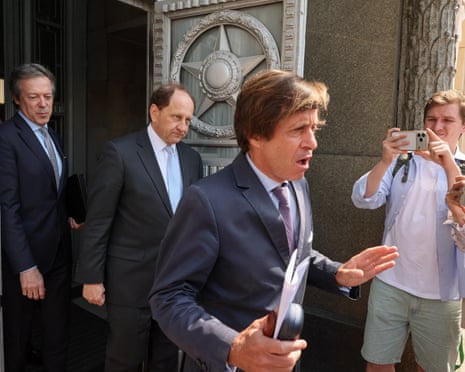 British, French and German ambassadors to Russia Nicolas de Riviere of France, Alexander Graf Lambsdorff of Germany and Nigel Casey of Britain leave the Russian foreign ministry headquarters in Moscow. Photograph: Shamil Zhumatov/Reuters
theguardian.com
British, French and German ambassadors to Russia Nicolas de Riviere of France, Alexander Graf Lambsdorff of Germany and Nigel Casey of Britain leave the Russian foreign ministry headquarters in Moscow. Photograph: Shamil Zhumatov/Reuters
theguardian.com
 Footage released by Ukrainian army appears to show drone attacks on bridge and trucks – loop
theguardian.com
Footage released by Ukrainian army appears to show drone attacks on bridge and trucks – loop
theguardian.com
E3 ambassadors met Russian officials in Moscow on Thursday, urging direct peace talks between Russia and Ukraine, according to the Guardian. France’s Nicolas de Rivière, Germany’s Alexander Graf Lambsdorff and Britain’s Nigel Casey went to the Russian foreign ministry and later issued a joint statement backing Volodymyr Zelenskyy’s call for direct talks between Moscow and Kyiv.
The visit is unusual in a war where European diplomats are more often summoned than invited, and where Russia has repeatedly signalled it prefers to bargain with Washington rather than with European capitals. The Guardian reports that US-led efforts have so far failed to produce a breakthrough and have been pushed further off the agenda by the Iran war, creating space for European governments to test whether any channel is still open. Moscow’s response, in the same reporting, was to accuse the E3 of pursuing a “destructive” policy and of wanting to continue the war “on behalf of and at the expense of European countries” — a familiar line that frames European support for Ukraine as something done to Europe, not by it.
What makes the timing awkward is that the battlefield is simultaneously being shaped by logistics attacks rather than by negotiating texts. The Guardian, citing Reuters and Ukrainian accounts, describes intensified Ukrainian drone strikes on supply lines into occupied southern Ukraine and Crimea, including the R-280 route from Rostov-on-Don via the Sea of Azov coastline. Ukraine’s drone forces commander Robert Brovdi said military cargo traffic on that route fell by 71% over two weeks. Separately, Ukrainian strikes were reported to have suspended traffic on the Chonhar Bridge, one of the links between occupied Kherson region and Crimea.
The immediate economic signal of those attacks showed up not in communiqués but at petrol stations. Reuters witnesses, as relayed by the Guardian, reported fuel stations in Russian-held Crimea running out of petrol, with rationing and long queues at the remaining outlets. Sevastopol’s Russian-backed governor Mikhail Razvozhaev acknowledged delays in distributing rationed fuel and linked them to disrupted deliveries, while other Moscow-installed officials reported damage to bridges and infrastructure. When fuel cannot reliably reach a garrisoned peninsula by road, rail or barge, the cost is paid in slowed transport, idled vehicles and a constant diversion of effort to patch and protect routes.
The E3’s pitch for talks lands in that context: Europe is trying to insert itself as a diplomatic actor at the same moment Ukraine is trying to reduce Russia’s room to manoeuvre by making occupied territory expensive to supply. If Moscow calculates that time and distance are on its side, European envoys become another audience to manage. If shortages and bottlenecks worsen, the same envoys become a channel to explore terms without conceding anything in public.
On Thursday, three ambassadors crossed the threshold of Russia’s foreign ministry and asked for direct talks. The same day, motorists in Sevastopol were reported queueing at the city’s few working petrol stations.