
Thailand announces death of Princess Bajrakitiyabha
Coma followed collapse during exercise in 2022, succession questions widen under strict lese majesty limits
Images
 She was the eldest of King Vajiralongkorn's seven children
bbc.com
She was the eldest of King Vajiralongkorn's seven children
bbc.com
 She was the eldest of King Vajiralongkorn's seven children
bbc.com
She was the eldest of King Vajiralongkorn's seven children
bbc.com
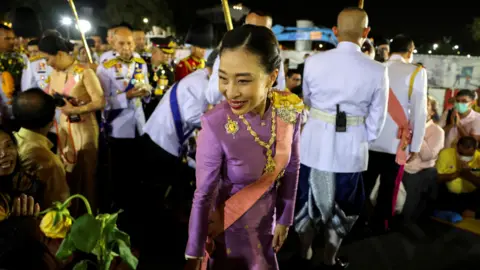 Reuters Thailand's Princess Bajrakitiyabha greets her royalists as she leaves a religious ceremony to commemorate the death of King Chulalongkorn, known as King Rama V, at The Grand Palace in Bangkok, Thailand, October 23, 2020.
bbc.com
Reuters Thailand's Princess Bajrakitiyabha greets her royalists as she leaves a religious ceremony to commemorate the death of King Chulalongkorn, known as King Rama V, at The Grand Palace in Bangkok, Thailand, October 23, 2020.
bbc.com
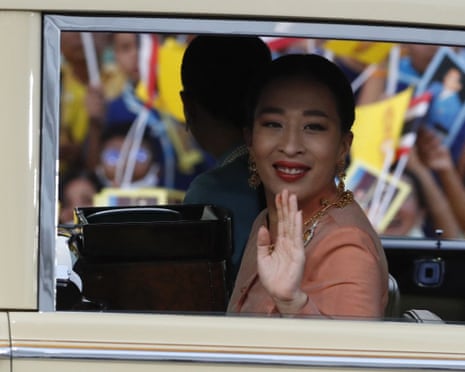 Princess Bajrakitiyabha Mahidol of Thailand has died, aged 47. The late princess is pictured waving to crowds during a procession in Bangkok on 1 November 2020. Photograph: Rungroj Yongrit/EPA
theguardian.com
Princess Bajrakitiyabha Mahidol of Thailand has died, aged 47. The late princess is pictured waving to crowds during a procession in Bangkok on 1 November 2020. Photograph: Rungroj Yongrit/EPA
theguardian.com
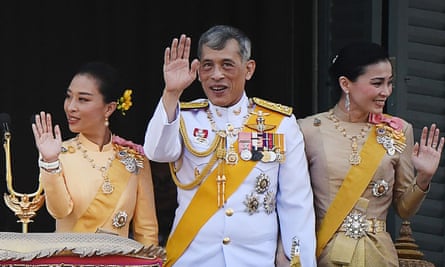 Thailand’s King Maha Vajiralongkorn with Princess Bajrakitiyabha Mahidol on the left and Queen Suthida Photograph: Jewel Samad/AFP/Getty Images
theguardian.com
Thailand’s King Maha Vajiralongkorn with Princess Bajrakitiyabha Mahidol on the left and Queen Suthida Photograph: Jewel Samad/AFP/Getty Images
theguardian.com
Thailand’s royal household announced that Princess Bajrakitiyabha has died after spending more than three years in a coma, according to the BBC and the Guardian. She collapsed in December 2022 while exercising her dogs and never recovered, with doctors attributing the initial crisis to a severely irregular heartbeat linked to an infection. The BBC reports she died at Chulalongkorn Hospital at 19:48 local time the day before the announcement.
Bajrakitiyabha, 47, was the eldest of King Maha Vajiralongkorn’s seven children and one of the few to hold a royal title, the Guardian notes. Her public profile was unusually modern for Thailand’s palace: trained as a lawyer, educated at Cornell University, and posted as ambassador to Austria, she also worked with the UN Office on Drugs and Crime and campaigned for penal reform, with a focus on women in prison. The BBC adds that she argued against severe sentences for minor drug possession—an area where Thailand’s criminal justice system has long produced high inmate numbers.
Her death also removes a figure around whom Thailand’s succession questions had quietly accumulated. Vajiralongkorn has not named an heir, and while Thai custom favours a male successor, a constitutional amendment allows a woman to take the throne, according to the BBC. The presumed heir is Prince Dipangkorn, but both the BBC and the Guardian describe persistent uncertainty about his ability to perform the role, a topic that rarely surfaces openly.
That silence is not cultural accident. The Guardian points to Thailand’s strict lese majesty law, under which criticism of the royal family can carry long prison sentences, narrowing what can be said in public about the institution and its future. The result is that succession—a question that in many countries becomes a visible political and constitutional process—tends to be managed as a private matter with legal penalties attached to speculation.
Bajrakitiyabha’s career, spanning state legal institutions, international diplomacy and palace security roles, had made her a plausible bridge between the monarchy’s internal hierarchy and the modern bureaucracy that governs day-to-day Thailand. The BBC reports that in 2021 the king appointed her chief of staff in his private bodyguard, with the rank of general, a signal of trust that fed rumours about a larger role.
She died at a Bangkok hospital after years of intensive care, and Thailand still has a king who has not named an heir.