
SpaceX targets nearly $1.8 trillion valuation in Nasdaq debut
$75 billion share sale leaves Elon Musk with over 84% voting control, public investors buy exposure without governance
Images
 bbc.com
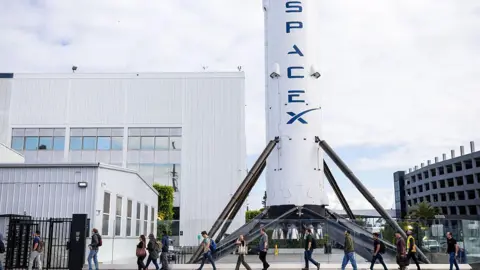 Getty Images A row of people walk past a large white rocket with blue "space x" logo written on it.
bbc.com
Getty Images A row of people walk past a large white rocket with blue "space x" logo written on it.
bbc.com
SpaceX is set to begin trading on Friday at a valuation of nearly $1.8 trillion after raising $75 billion in a share sale priced at $135, according to the BBC.
The flotation would make the rocket and satellite company one of the most valuable public firms in the world, and it would put its chief executive Elon Musk in line to become the world’s first trillionaire on paper. The BBC reports Musk holds roughly 40% of SpaceX’s equity and more than 84% of its voting power through a dual-class structure, leaving outside shareholders with limited leverage over governance even after the company lists on the Nasdaq.
The size of the deal matters because SpaceX sits at the intersection of private capital markets and government procurement. A public listing expands the pool of investors who can fund a capital-intensive business, but the company’s revenue base and risk profile remain tied to launch contracts and regulatory permission in ways that software firms are not. That combination tends to produce a particular kind of public-company tension: investors price growth and dominance, while the operational reality is heavy manufacturing, long lead times, and a dependence on state customers whose priorities can change with budgets and politics.
The governance terms sharpen that tension. Harvard Law School analysis cited by the BBC warns that Musk’s control could expose investors to conflicts around business deals and compensation, including transactions involving other Musk-owned entities. The BBC notes SpaceX has acquired xAI, and that xAI acquired the social media platform X in 2025—moves that can be framed as strategic integration, but which also concentrate decision-making and related-party risk in one person’s hands.
The offering is also being treated as a benchmark for other high-profile private AI companies expected to test public markets. The BBC describes SpaceX as a “test case” for firms with valuations near $1 trillion, naming Anthropic and OpenAI. If SpaceX trades strongly, it will validate the idea that investors are willing to absorb very large, founder-controlled listings; if it trades poorly, it will raise questions about whether private-market valuations can survive the discipline of daily pricing.
For now, the numbers are straightforward: $75 billion raised, $135 per share, nearly $1.8 trillion implied value. The company will be public, but control will remain private in practice.