
NOAA declares El Niño conditions underway
Models point to very strong warming later this year, global heat records now depend on a Pacific threshold crossing
Images
 bbc.com
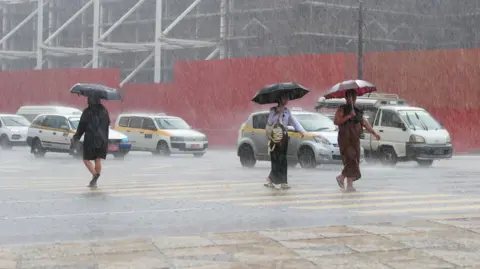 EPA/Shutterstock Three people walking across a road in heavy rain in Myanmar, with traffic in the background. All are holding umbrellas, as the rain bounces off the road crossing
bbc.com
EPA/Shutterstock Three people walking across a road in heavy rain in Myanmar, with traffic in the background. All are holding umbrellas, as the rain bounces off the road crossing
bbc.com
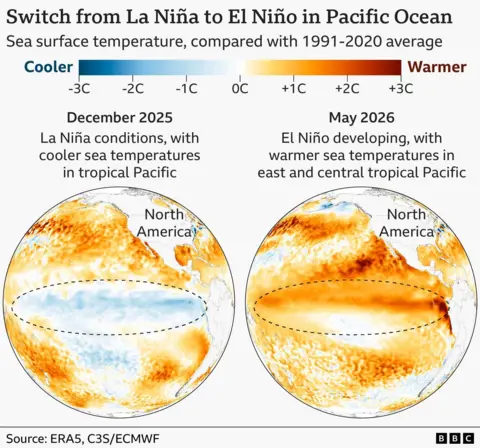 A graphic of two global maps with one showing in blue, cooler conditions in a key section of the Pacific in December last year, with a second one showing conditions in May this year, with red indicating a far greater amount of heat coming to the surface of sea.
bbc.com
A graphic of two global maps with one showing in blue, cooler conditions in a key section of the Pacific in December last year, with a second one showing conditions in May this year, with red indicating a far greater amount of heat coming to the surface of sea.
bbc.com
US scientists say El Niño conditions are now underway in the tropical Pacific, after sea-surface temperatures rose past the threshold used to classify the pattern, according to the BBC. The US National Oceanic and Atmospheric Administration (NOAA) said warming has developed across the central to eastern equatorial Pacific and that winds above the equator are beginning to shift in response. Forecasts cited by the BBC suggest the episode could become a very strong event later this year.
El Niño is not a storm but a reconfiguration of ocean heat that tends to raise global average air temperatures by releasing warmth from the Pacific into the atmosphere. NOAA’s June outlook put the chance of a “very strong” El Niño—defined as more than 2°C above average in a key Pacific zone—at 63% for November to January, the BBC reports. Some US and European models, including the ECMWF, project tropical Pacific temperatures could rise more than 3°C above average by the end of the year, a range that would place the event among the largest recorded since 1950.
The economic risk is less about any single headline and more about synchronized stress across systems that already run close to capacity: harvest planning, power demand, water management, and disaster response. El Niño’s impacts are uneven, but the BBC notes that disruptions are often most severe in tropical regions, where agriculture and infrastructure have less slack. Northern Peru commonly sees flooding during El Niño events, and the BBC describes drought impacts in southern Africa through the example of a Zambian farmer holding a small ear of corn from a previous episode.
This cycle is arriving on top of a hotter baseline. Prof Adam Scaife of the UK Met Office told the BBC that the new El Niño is superimposed on substantial global warming, which means regional extremes can land beyond previous experience even when the ocean pattern itself is “only” comparable to past events. The BBC notes that 2024—the warmest year on record—was influenced by an El Niño that was not especially strong, while 2025 remained the third warmest year despite La Niña’s cooling tendency.
NOAA cautioned that even very strong El Niño events do not produce expected outcomes everywhere, but stronger events increase the odds of the typical pattern. Scaife expects very high global temperatures at the end of 2026 and into 2027, and the BBC reports that 2027 could see excess heat on top of long-term warming, with the potential for a year exceeding 1.5°C above late-19th-century levels.
For now, the signal is technical and specific: Pacific sea-surface temperatures have crossed the line, and the atmosphere is starting to follow.