
Northern Ireland police use water cannon against rioters
Second night of anti-immigration unrest follows north Belfast stabbing, burnt vehicles and a still-burning house mark the dispersal
Images
 Water cannon used on rioters in Belfast – video
theguardian.com
Water cannon used on rioters in Belfast – video
theguardian.com
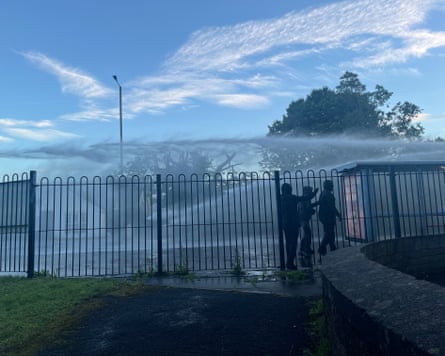 Police water cannon in Sandyknowes, Belfast. Photograph: Hannah Al-Othman/The Guardian
theguardian.com
Police water cannon in Sandyknowes, Belfast. Photograph: Hannah Al-Othman/The Guardian
theguardian.com
Police in Northern Ireland used water cannon to disperse a crowd of about 300 people near the Sandyknowes roundabout outside Newtownabbey on Wednesday night, after a second evening of anti-immigration unrest, according to The Guardian. Officers faced bricks and petrol bombs, while a truck was set on fire and makeshift barricades were built from torn-up fencing, tyres and furniture. The disorder followed a knife attack in north Belfast on Monday night that left a man, Stephen Ogilvie, severely injured; police have charged Hadi Alodid, 30, with attempted murder and with possessing a knife in a public place, the paper reports.
The week’s violence has quickly turned from a criminal case into a contested story about who belongs and who pays for social breakdown. The Guardian reports that on Tuesday night mobs targeted ethnic minorities, with police later warning that some people were “weaponising” others’ anger. By Wednesday, several advertised protests—including one at Belfast City Hall—did not happen, while a smaller protest at Stormont passed off peacefully, suggesting mobilisation is uneven and sensitive to policing and weather, not just sentiment. Yet the Sandyknowes confrontation lasted hours before dispersal around 11.30pm, leaving burnt-out vehicles, torn-up driveways used as ammunition, and firefighters tackling a still-burning empty house.
The details also show how quickly public order becomes a spectator sport. The Guardian describes spectators filming from a nearby park and a rioter threatening them to stop recording, while an older woman stood at a bus stop between police and protesters and refused to move, saying she had lived through the Troubles. The family of the stabbing victim publicly condemned the violence and appealed for an end to misinformation, a sign that the immediate victims can lose control of the narrative once online rumours and street mobilisation take over.
Stormont ministers issued a joint statement condemning the disorder and warning it spread fear and risked innocent lives. But the state’s most visible response has been tactical—water cannon, dispersal orders, and clearing roads—while the deeper question is how quickly a single violent incident can be repurposed into threats against people who had nothing to do with it.
By the end of the standoff, the area around Sandyknowes was littered with bricks and debris, and police had moved on to the next flashpoint.