
Johannesburg mass shooting kills 12
Attackers arrive in minibus taxi and flee before police arrive, a city with high murder rates keeps absorbing new crime scenes
Images
 No arrests have been made but the police say they are following all possible leads
bbc.com
No arrests have been made but the police say they are following all possible leads
bbc.com
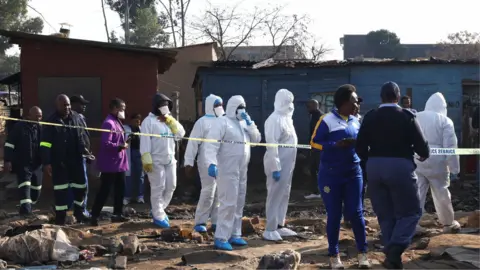 No arrests have been made but the police say they are following all possible leads
bbc.com
No arrests have been made but the police say they are following all possible leads
bbc.com
 Getty Images/BBC A woman looking at her mobile phone and the graphic BBC News Africa
bbc.com
Getty Images/BBC A woman looking at her mobile phone and the graphic BBC News Africa
bbc.com
Twelve people were killed late Tuesday in a mass shooting in Cleveland, an informal settlement in Johannesburg, after police say more than 10 suspects arrived in a minibus taxi and opened fire at multiple locations before fleeing. The BBC reports that nine others were injured and that no arrests had been made as police launched a manhunt.
Police said the attackers were dropped off near a petrol station by a white Toyota Quantum, then split to enter the settlement through both entrances. Witness accounts and a crime-scene breakdown released by police suggest a coordinated sweep rather than a single confrontation: eight men and three women died at the scene, and another man later died in hospital. The motive was not disclosed, and South African police framed the case as an active investigation rather than a resolved gang feud.
The episode lands in a city where lethal violence is routine enough to be measured as an average, not a shock. South Africa’s murder rate is among the highest in the world, with roughly 60 people killed per day on average, according to figures cited by the BBC. Informal settlements concentrate the ingredients that make clearance rates hard: dense housing, limited lighting and access points, and residents who often distrust or fear the state’s ability to protect them after cooperating.
Firearms are the accelerant. Gideon Joubert of the South African Gunowners’ Association told the BBC that there are about three million legally held firearms in the country and at least as many unlicensed weapons. That estimate points to a market where guns can circulate outside formal checks at scale, allowing disputes—whether criminal, political, or personal—to be settled with the same tool. In that environment, policing becomes less about preventing attacks than about responding after the fact, when suspects have already dispersed into a city with many places to hide and few incentives for witnesses to identify them.
Johannesburg has seen similar incidents before: the BBC notes that last year nine people were killed in a mass shooting at a tavern in the city. Each new mass shooting adds pressure for visible enforcement, but the pattern also shows how quickly violence relocates between venues—taverns, streets, settlements—when weapons and offenders remain mobile.
On Tuesday night, police arrived at about 23:10 local time to an informal settlement where the attackers had already left in the same vehicle they arrived in. By morning, the investigation had a crime scene and a description of a minibus taxi, but no suspects in custody.