
Trump says Iran shot down US military helicopter
Pentagon says crew rescued by unmanned sea drone in Strait of Hormuz, response still undefined as White House talks up deal
Images
 bbc.com
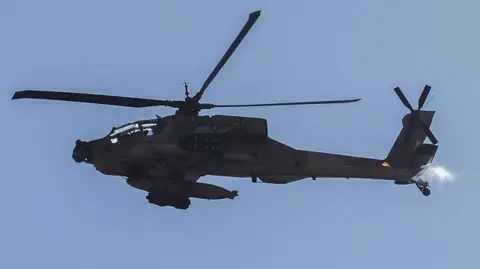 Getty Images This picture taken from a position in northern Israel, on the border with southern Lebanon, shows an Israeli Air Force AH-64 Apache helicopter flying on 4 June 2026.
bbc.com
Getty Images This picture taken from a position in northern Israel, on the border with southern Lebanon, shows an Israeli Air Force AH-64 Apache helicopter flying on 4 June 2026.
bbc.com
 Middle East crisis live: Donald Trump says Iran shot down military helicopter and US ‘must’ respond
theguardian.com
Middle East crisis live: Donald Trump says Iran shot down military helicopter and US ‘must’ respond
theguardian.com
A US military helicopter went down over the Strait of Hormuz on Monday night, and President Donald Trump said Iran shot it down, vowing the United States “must, of necessity, respond.” According to the BBC, the two crew members were rescued uninjured after a Pentagon statement said an American unmanned surface drone picked them up and ferried them to a point where they could be hoisted to a helicopter.
The immediate military facts remain contested. A US official told CBS News it was unclear whether the drone that recovered the crew had deliberately attacked the helicopter, and Iran’s semi-official Mehr News Agency reported that Tehran had not claimed responsibility. That ambiguity matters because it leaves Washington room to choose a response while keeping open the option of de-escalation—especially as Trump has simultaneously been talking up diplomacy, telling reporters that a “very good deal” with Iran could be days away and suggesting the strait would “open immediately” after an agreement.
The rescue details point to a broader shift in how the US is trying to police the region. US Central Command said the recovery was led by US Naval Forces Central Command and the 82nd Airborne Division, with support from US Air Force and Navy units including the 5th Fleet’s Task Force 59, a Bahrain-based unit launched in 2024 to deploy unmanned systems alongside manned operators. In practice, that means the same waterway being fought over is also becoming a proving ground for cheaper, more disposable platforms—useful for surveillance and recovery, but also for lowering the political cost of keeping forces forward-deployed.
The downing comes against a backdrop of fragile, overlapping ceasefires and threats. The BBC reports Iranian foreign minister Abbas Araqchi warning that “foreign forces” near Iran’s territory are at constant risk from human error, accidents, or crossfire, and suggesting they should leave to reduce the danger. At the same time, Israeli strikes across southern Lebanon continued on Tuesday, with Tehran warning that attacks there could trigger retaliation—linking separate fronts through a single logic of deterrence.
For Europe, the Strait of Hormuz is less a talking point than a price mechanism: when the passage is disrupted, insurance, shipping schedules, and energy costs adjust faster than diplomats do. Trump’s promise that the strait would reopen after a deal effectively turns a global chokepoint into a deliverable in a bilateral negotiation—while US and Iranian forces continue operating close enough that a single incident can force both sides to explain themselves.
CENTCOM put the rescue time in a precise timestamp. The response Trump has promised did not come with one.