
Mehdi Hasan: UK and US tighten speech and border powers around Palestine
Proscription votes and visa leverage target activists and students, free-speech branding survives the paperwork
Images
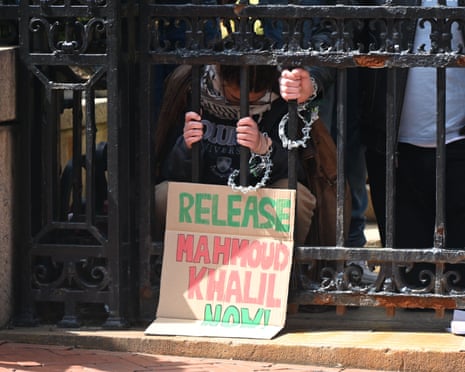 Supporters of Palestinian activist Mahmoud Khalil chain themselves to a fence at Columbia University, New York, 2 April 2025. Photograph: Kyle Mazza/NurPhoto/REX/Shutterstock
REX/Shutterstock
Supporters of Palestinian activist Mahmoud Khalil chain themselves to a fence at Columbia University, New York, 2 April 2025. Photograph: Kyle Mazza/NurPhoto/REX/Shutterstock
REX/Shutterstock
 Mehdi Hasan
theguardian.com
Mehdi Hasan
theguardian.com
Mehdi Hasan argues in the Guardian that a set of politicians and commentators who once styled themselves as free-speech maximalists in the UK and US have become willing to curtail speech when it centers on Palestine.
His evidence is procedural and concrete rather than theoretical. In Britain, the government has moved to proscribe the direct action group Palestine Action as a terrorist organisation, a step backed by 385 MPs across party lines, according to Hasan. He writes that police have detained people — including priests, elderly and disabled protesters — for holding signs reading “I oppose genocide; I support Palestine Action.” At the border, he says the UK has blocked US political commentators Cenk Uygur and Hasan Piker from entering, with the Home Office offering only the formula that their presence was not “conducive to the public good”; Hasan reports it was said to relate to fears of exacerbating antisemitism. Piker’s own record, Hasan notes, includes past remarks he later regretted, now being used as a justification for exclusion.
In the US, Hasan describes a parallel pattern: enforcement pressure aimed not at violence but at speech and association. He points to cases involving foreign students such as Mahmoud Khalil and Rümeysa Öztürk, whom he says were investigated, arrested, or detained over protected expression. Öztürk’s cited conduct, Hasan writes, included co-authoring a student newspaper op-ed urging Tufts University to divest from companies connected to Israel. He also highlights congressional activity — resolutions proposed and passed — that he says is designed to narrow the space for pro-Palestinian advocacy. Even within the US legal establishment, Hasan notes, a right-wing judge appointed by Ronald Reagan described the crackdown on student protesters as a “full-throated assault on the first amendment across the board under the cover of an unconstitutionally broad definition of antisemitism.”
The common thread in Hasan’s account is that restrictions become easiest to sell when packaged as public order and social cohesion, because the costs land on people with weak institutional protection: students on visas, activists without major-party patrons, and ordinary demonstrators who can be processed quickly and quietly. Border bans and terrorism designations also shift decisions away from open courtrooms and into administrative discretion, where the state can cite broad tests like “public good” while providing little detail.
Hasan frames the result as a stress test of proclaimed principles: the speech that most needs defending is the speech that triggers complaints, reputational risk, and political pressure.
His examples are not about a single gag order or one campus dispute. They are about how quickly a slogan about free expression turns into a set of forms, votes, and entry denials once the subject is Palestine.