
Pashinyan heads for decisive win in Armenia election
Early results show Civil Contract leading as Russia applies import bans and influence claims swirl, balanced foreign policy gets tested in customs lines
Images
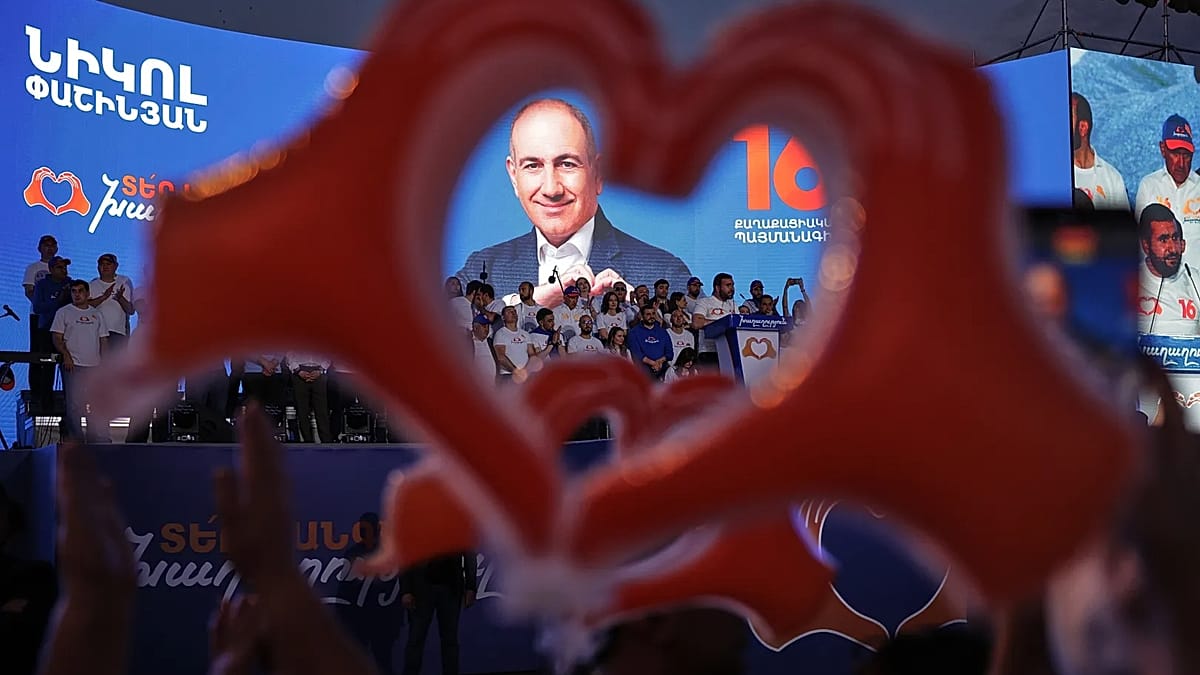 Pashinyan hails 'historic victory' in decisive election in Armenia
euronews.com
Pashinyan hails 'historic victory' in decisive election in Armenia
euronews.com
Armenians voted on Sunday in an election that early results suggest will return Prime Minister Nikol Pashinyan with a stronger mandate, according to Euronews, after a campaign dominated by security fears and arguments over the country’s geopolitical direction. With more than 60% of votes counted on Monday, Pashinyan’s Civil Contract party led on 51.2%, ahead of the Strong Armenia alliance led by Russian-Armenian billionaire Samvel Karapetyan on 23%, with ex-president Robert Kocharyan’s Armenia alliance on 9.9%. The Central Election Commission put turnout at 59%.
The vote comes after a period in which Armenia’s formal alliance with Russia has looked increasingly transactional. Euronews reports that Pashinyan has sought to loosen dependence on Moscow after Russia failed to help during the Nagorno-Karabakh conflict, while insisting publicly there is “no question” of choosing between Russia and the West. That balancing language is paired with a practical reality: when security guarantees feel unreliable, governments shop for alternatives, and the price is often paid in trade.
Russia’s leverage has shown up in the customs queue rather than on the battlefield. In the weeks before the election, Euronews says Russia banned imports of several Armenian products, a move widely read in Yerevan as economic pressure as Armenia edges towards closer cooperation with the EU. The campaign itself became a contest over who could best argue that their opponents were gambling with war: Pashinyan warned voters of a “catastrophic war” with Azerbaijan within months if he failed to secure a strong majority, while opposition parties accused him of fearmongering and alleged electoral violations and repression.
The election also highlighted how outside actors can try to shape small-state politics without sending troops. Euronews cites analysts pointing to misinformation, hacker activity and Kremlin-friendly narratives portraying Western cooperation as dangerous, alongside Armenian officials warning that “enemies of freedom” were funding propaganda. Those claims are hard to quantify in real time, but they fit a pattern familiar across the region: influence operations are cheap, deniable, and most effective when they amplify existing distrust.
Pashinyan, who came to power in a 2018 street revolution, framed his message around closing the chapter with Azerbaijan and institutionalising peace, while also signalling he wants continued relations with Russia and a “balanced foreign policy”. He also received a “TOTAL Endorsement for Re-Election” from US President Donald Trump, Euronews reports—an intervention that costs Washington little but gives domestic opponents another foreign label to attach to the incumbent.
As ballots were counted in Yerevan, Russia’s import bans were already in place. Armenia’s next government will have to decide how much sovereignty it can afford to buy at the border.