
Israel strikes Iran after Beirut attack triggers missile exchange
Trump says he urged Netanyahu to hold back as White House stays silent on coordination, regional airspace closures and base sirens spread the cost
Images
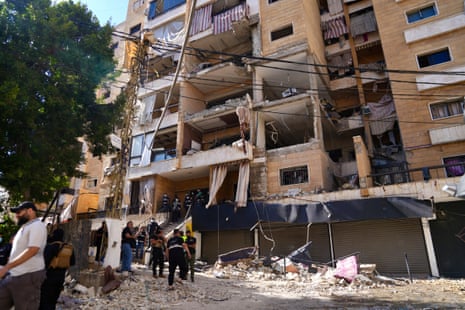 Rescuers work at the site of an Israeli airstrike that hit a building in the southern suburbs of Beirut on Sunday. That strike triggered retaliatory missile launches from Iran. Photograph: Abbas Salman/EPA
theguardian.com
Rescuers work at the site of an Israeli airstrike that hit a building in the southern suburbs of Beirut on Sunday. That strike triggered retaliatory missile launches from Iran. Photograph: Abbas Salman/EPA
theguardian.com
Israeli strikes hit central and western Iran on Monday, according to The Guardian, after Iran fired about 10 ballistic missiles towards northern Israel in response to an earlier Israeli strike on Beirut’s southern suburbs. Lebanon’s health ministry said two people were killed and 20 wounded in the Beirut attack, while Israel said the Iranian missiles were intercepted or fell in open areas.
The timing turned the exchange into a test of chain-of-command as much as air defence. US President Donald Trump told Fox News he wanted Iran to stop firing and return to negotiations, and he publicly insisted that he “call[s] all the shots” after urging Israeli Prime Minister Benjamin Netanyahu not to retaliate immediately. A senior US official told The Guardian Trump believed he had convinced Netanyahu to wait; hours later, Israel hit targets inside Iran anyway, and the White House declined to say whether the strikes were coordinated.
For Israel, the logic of striking quickly is straightforward: a missile barrage, even one that causes limited damage, creates pressure to demonstrate deterrence, and it is easier to justify escalation while the last attack is still on screens. For Iran, answering a strike in Beirut with missiles towards Israel keeps the confrontation framed as retaliation rather than initiation, while also drawing in allied groups that can add pressure without Tehran taking every risk directly. The Guardian reports Israel was also working to intercept a missile launched from Yemen, and notes that the Houthis have attacked Israel since March.
The spillover is already visible in the region’s alert systems. Saudi Arabia sounded missile sirens near Prince Sultan airbase, which hosts US forces, underscoring how quickly a bilateral exchange turns into a wider force-protection problem for Washington’s partners. Iran’s closure of airspace around Tehran’s Imam Khomeini international airport after reported explosions in several cities adds a civilian cost that compounds with each round: flights cancelled, insurance premiums repriced, and commercial planning subordinated to military tempo.
The ceasefire that paused the US-Israel war with Iran in April was supposed to reduce the risk of direct state-on-state strikes. Instead, Monday’s attacks became the first direct Israel-Iran strikes since that pause, according to The Guardian, and they arrived alongside competing claims about who authorised what. Iran’s parliament speaker Mohammad Bagher Ghalibaf accused the US of giving a “green light” for the Beirut attack and warned US and Israeli assets were now “legitimate targets”, language that widens the list of possible targets faster than diplomats can narrow it.
Rescuers were still working at the Beirut strike site as markets and militaries recalculated. Iran closed the airspace around its main airport; Saudi sirens sounded near a base hosting US troops; and the White House left unanswered whether any of it was coordinated.