
Trump-appointed Ninth Circuit judge faces Idaho battery charge
Parking dispute allegedly ends with smashed glasses on video, lifetime tenure meets local misdemeanour docket
Images
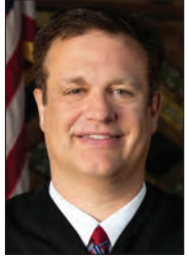 Judge Ryan Nelson is accused of knocking a man’s glasses off his head and stomping on them in a parking lot. he has pleaded not guilty to the charges (Ninth Circuit Court of Appeals)
Ninth Circuit Court of Appeals
Judge Ryan Nelson is accused of knocking a man’s glasses off his head and stomping on them in a parking lot. he has pleaded not guilty to the charges (Ninth Circuit Court of Appeals)
Ninth Circuit Court of Appeals
A Trump-appointed federal appeals judge has been charged in Idaho with two misdemeanours after a dispute over parking escalated into an alleged assault and property damage. According to The Independent, Ryan D. Nelson of the Ninth Circuit Court of Appeals faces one count of battery and one count of malicious injury to property over an early-April confrontation in a parking lot. The case is unusually concrete for a sitting federal judge: the Idaho State Journal obtained security footage that appears to show the encounter, and a court docket shows Nelson pleading not guilty.
The allegations are small-bore—an argument, a pair of glasses, a stomp—but the institutional setting is not. Federal appellate judges hold lifetime appointments and decide questions that shape immigration enforcement, policing powers, and administrative authority across large parts of the United States. The Independent reports that Nelson had no prior experience as a judge when he was nominated in 2018, a detail that has become a familiar feature of modern confirmation battles: credentials that would once have been disqualifying become secondary to reliability in high-stakes ideological cases.
The reporting also illustrates how accountability works in practice when a public office is insulated by design. Criminal charges in a local court are one of the few mechanisms that can touch a federal judge’s personal conduct quickly; professional discipline and impeachment are slower, political processes, and often start only after public pressure builds. Nelson’s lawyer, Curtis Smith, told The Independent the charges are unrelated to Nelson’s judicial role and that he will work through the legal system—language that would be routine for any defendant, but reads differently when the defendant is part of the system.
The alleged victim told the Idaho State Journal that the argument began after he criticised Nelson’s parking. In the video described by the paper, Nelson is seen grabbing the man’s glasses and throwing them across the lot; as the man goes to retrieve them, Nelson appears to run ahead and stomp on them. An affidavit cited by The Independent says the victim reported being challenged to a fight, while a law-enforcement officer noted that Nelson admitted knocking the glasses off and stomping on them, but denied touching the man.
Nelson is not a backbench jurist. The Independent notes he has ruled in several high-profile cases, including one that sided with President Trump over deployment of National Guard troops during protests in Portland. That is the quiet second-order effect of appointment politics: a single personnel decision can outlast the administration that made it, while the mechanisms for removing the appointee are narrow and rarely used.
The case now turns on a local criminal process—arraignments, motions, and evidence—rather than judicial privilege. The security footage exists, the glasses are a physical object, and the charges are misdemeanours that do not require a national controversy to proceed.
A federal appellate judge with a lifetime seat is, for now, answering to an Idaho court over what happened in a parking lot in early April.