
Bernadette Chirac dies aged 93
Former French first lady stayed in politics after Jacques Chirac left office, her last public appearance came at a small-town street naming
Images
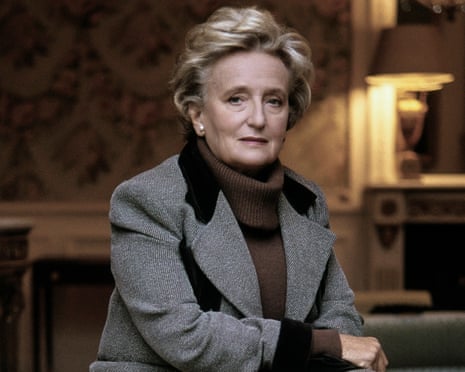 Bernadette Chirac described the 63 years she was together with her husband Jacques as a long lesson in endurance. Photograph: Derek Hudson/Getty Images
theguardian.com
Bernadette Chirac described the 63 years she was together with her husband Jacques as a long lesson in endurance. Photograph: Derek Hudson/Getty Images
theguardian.com
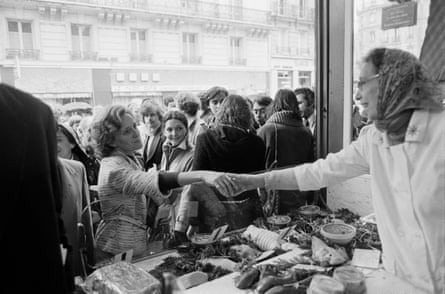 Bernadette Chirac visiting a market in Place Maubert during her husband’s campaign to be elected Mayor of Paris, France, 24 February 1977. Photograph: Jacques Pavlovsky/Sygma/Getty Images
theguardian.com
Bernadette Chirac visiting a market in Place Maubert during her husband’s campaign to be elected Mayor of Paris, France, 24 February 1977. Photograph: Jacques Pavlovsky/Sygma/Getty Images
theguardian.com
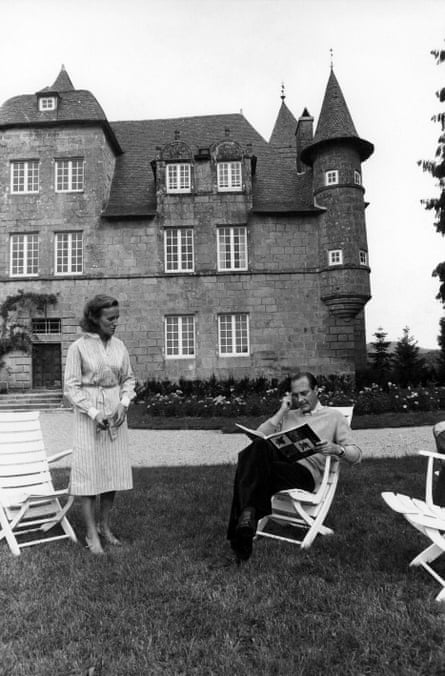 Bernadette and Jacques Chirac at the Château de Bity in Sarran after departing his role as prime minister. Sarran, France, 30 August 1976. Photograph: ANDBZ/ABACA/Shutterstock
theguardian.com
Bernadette and Jacques Chirac at the Château de Bity in Sarran after departing his role as prime minister. Sarran, France, 30 August 1976. Photograph: ANDBZ/ABACA/Shutterstock
theguardian.com
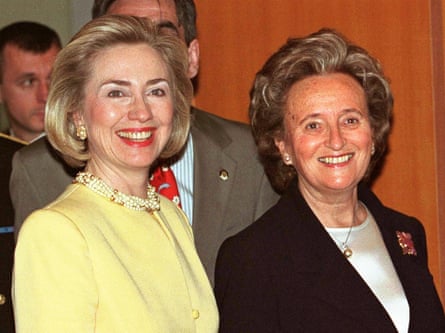 Bernadette Chirac with the then US first lady, Hillary Clinton, as they arrive at the Correze Regional Council in Tulle, central France, 12 May 1998. Photograph: Jacky Naegelen/AP
theguardian.com
Bernadette Chirac with the then US first lady, Hillary Clinton, as they arrive at the Correze Regional Council in Tulle, central France, 12 May 1998. Photograph: Jacky Naegelen/AP
theguardian.com
Bernadette Chirac, the widow of former French president Jacques Chirac, has died aged 93, The Guardian reports. She was France’s first lady for 12 years and remained politically active after her husband left office in 2007, serving as a councillor in Corrèze, their constituency in central France. Her last public appearance was in 2018, when a street in Brive-la-Gaillarde was named after the couple, according to the paper.
Chirac’s public role was shaped by proximity to one of the Fifth Republic’s most durable political careers—two stints as prime minister, 18 years as mayor of Paris and two terms as president—yet The Guardian describes her as something more than a ceremonial spouse. She was known as a behind-the-scenes operator, refusing to be confined to “wife of” duties, and for a sharp, often ironic style of put-down delivered in a nasal voice. Her visual signature—designer outfits, Chanel suits and large Dior sunglasses—made her both recognisable and easy to lampoon, a familiar trade-off for political families who must be constantly visible without appearing to campaign.
After Jacques Chirac retired, she told reporters: “My husband no longer does politics, but I do,” and joked that he was “looking after the dog,” The Guardian writes. The line worked because it described a practical division of labour inside a political household: one partner exits the stage, the other keeps the local network alive. In Corrèze, where French politics often runs on patronage, fundraising and personal loyalty, that continuity can matter as much as any national title.
The Guardian also recounts how she spoke publicly about her husband’s reputation as a womaniser, describing their 63 years together as “a long lesson in endurance” and saying she did not divorce him because of her Catholic upbringing and because she loved him. The details sit uncomfortably alongside the polished public image of the presidential couple, but they also reflect a period when the private costs of political life were expected to be absorbed quietly by families, not litigated in public.
Jacques Chirac died in 2019, and Bernadette Chirac was too frail to attend his state farewell, according to The Guardian. Her last political declaration was simpler: she kept her seat in Corrèze after the Élysée years ended.
Her final public photograph was not in Paris but in Brive-la-Gaillarde, standing by a street sign bearing the Chirac name.