
Ukrainian drones strike St Petersburg region
Russian officials call attack unprecedented during economic forum, indoor warning arrives as war reaches showcase city
Images
 President Zelensky posted a video on social media of an unknown location showing drones and explosions
bbc.com
President Zelensky posted a video on social media of an unknown location showing drones and explosions
bbc.com
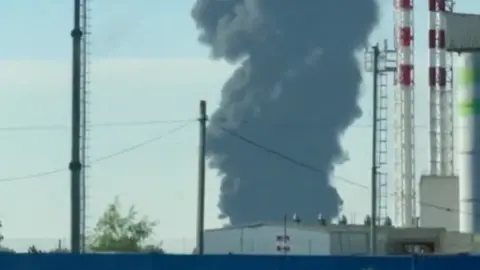 President Zelensky posted a video on social media of an unknown location showing drones and explosions
bbc.com
President Zelensky posted a video on social media of an unknown location showing drones and explosions
bbc.com
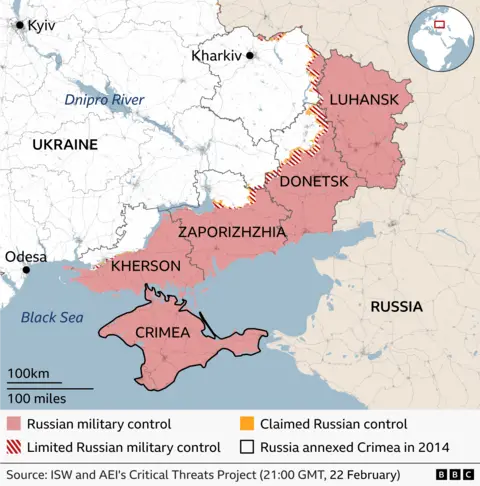 Map of Ukraine showing regions under Russian military control shaded red, limited control in red stripes, and claimed control shaded yellow as of 18 February. The regions of Luhansk, Donetsk, Zaporizhzhia, Kherson – with almost all of Luhansk shaded red and much of the other three provinces also under Russian control. Crimea which was annexed by Russia in 2014 is also are marked as under Russian control. Major cities labelled include Kyiv, Kharkiv, and Odesa. Source: ISW
bbc.com
Map of Ukraine showing regions under Russian military control shaded red, limited control in red stripes, and claimed control shaded yellow as of 18 February. The regions of Luhansk, Donetsk, Zaporizhzhia, Kherson – with almost all of Luhansk shaded red and much of the other three provinces also under Russian control. Crimea which was annexed by Russia in 2014 is also are marked as under Russian control. Major cities labelled include Kyiv, Kharkiv, and Odesa. Source: ISW
bbc.com
Ukrainian drones hit Russia’s St Petersburg region during the final day of the country’s annual economic forum, with Russian officials calling the barrage unprecedented and reporting more than 140 drones shot down over the Leningrad region. St Petersburg governor Alexander Beglov urged residents to stay indoors for the first time since the war began, while regional governor Aleksandr Drozdenko said the attack caused a fire at an unspecified military facility and only “insignificant” damage to buildings, according to the BBC.
The timing mattered. The forum draws thousands of guests from dozens of countries and functions as a showcase of normality and investment prospects; the same weekend, local authorities were issuing evacuation orders and indoor warnings. President Volodymyr Zelensky said Ukraine struck Russian arsenals and a naval base, and claimed drones travelled roughly 1,000 km to reach the area, including Kronstadt, described as the main outpost of Russia’s Baltic Fleet. In parallel, Moscow-installed authorities in occupied Luhansk suspended coach services on two motorways and restricted rail and group transport of children, after Ukrainian drone strikes targeted logistics routes.
The pattern is not a single spectacular raid but an operational shift. Since early May, Ukrainian drone forces have increasingly targeted logistics in occupied territory; a BBC-cited analyst said more than 200 lorries and over 30 fuel trucks had been hit over that period. Kyiv has also repeatedly aimed at energy infrastructure and oil facilities inside Russia, presenting these strikes as “long-range sanctions” designed to reduce Moscow’s ability to finance and supply the war. Each disruption forces Russia to spend manpower and equipment on air defence, route protection, and repairs—costs that do not appear on the battlefield maps but still compete with front-line needs.
For European governments, the spillover is less about immediate military risk and more about how quickly the war’s tools migrate across borders and into civilian life. Romania has already dealt with drone incidents linked to the conflict, and Baltic states have reported incursions; the St Petersburg strike shows that long-range drones are now routine enough to be deployed against symbolic and logistical targets far from the front. As ranges extend and production scales, the same technology that can ignite a fire at an “unspecified military facility” can also shut down a port, an airport, or a power substation for a day—creating political pressure without changing territorial lines.
Putin used his forum speech to reject Zelensky’s call for a meeting, saying a truce would allow Ukraine to regroup and insisting Russia would end the war only when its goals were met. Those stated conditions include Ukraine withdrawing from Donetsk, Luhansk, Kherson and Zaporizhzhia regions and abandoning efforts to join NATO—terms Kyiv rejects.
In St Petersburg, residents were told to stay indoors while delegates attended panels about the Russian economy.