
DoJ tells appeals court it cannot block Trump White House ballroom
Preservation lawsuit fights East Wing demolition order, bunker work continues while judges debate remedies
Images
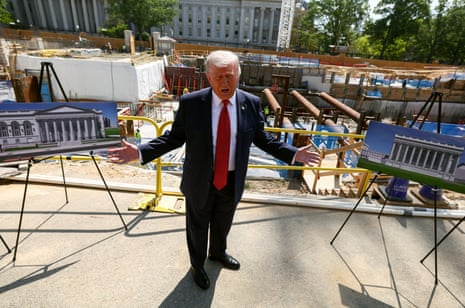 Donald Trump at the site of the planned White House ballroom in Washington DC on 19 May 2026. Photograph: Kevin Lamarque/Reuters
theguardian.com
Donald Trump at the site of the planned White House ballroom in Washington DC on 19 May 2026. Photograph: Kevin Lamarque/Reuters
theguardian.com
A Department of Justice lawyer told a US appeals court that judges may have no power to stop Donald Trump’s planned White House ballroom, after a lower court blocked construction that began without the usual approvals, according to The Guardian.
The dispute stems from a lawsuit by the National Trust for Historic Preservation against the National Park Service and the Trump administration after Trump ordered the demolition of the White House’s East Wing. The Guardian reports that construction began without completing, or even starting, the standard review processes required under district and federal statute. The administration has argued that national security needs justify the project, pointing to threats highlighted after an assassination attempt at a White House Correspondents Association event in April.
In court, the administration’s position went beyond defending this specific building plan. According to The Guardian, Justice Patricia Millett asked at what point the project became a fait accompli. Yaakov Roth, a principal deputy assistant attorney general, replied that courts might not be able to stop the project even if it amounted to “complete lawlessness by the government,” arguing that only Congress could pass a law to authorize or block the specific action. The exchange set up a blunt clash over who controls federal property in practice: Congress as the owner, or the president as a temporary tenant with the ability to move bulldozers first and litigate later.
The case also shows how “national security” can function as a procedural solvent. The Guardian notes that a secure underground facility for staff at the site was allowed to proceed even as the ballroom itself was blocked, creating an uneven landscape where some construction can advance while the underlying legal questions remain unresolved. Meanwhile, the political system has already been pulled into the project’s financing and scope: the US Senate advanced an immigration spending bill only after Republicans removed funding for Secret Service security upgrades tied to the proposed ballroom, The Guardian reports.
If the appeals court accepts the administration’s theory, the practical effect is that the speed of executive action becomes its own shield: once demolition and construction are underway, the remedy shifts from stopping the work to debating after-the-fact accountability. If the court rejects it, the decision would still land in a familiar place—protracted litigation, contested injunctions, and a project that can be partially built while the paperwork catches up.
The photograph The Guardian used to illustrate the case shows Trump at the construction site in Washington in May. The legal argument heard in court was that even a judge may not be able to make the site stop.