
Israel and Lebanon agree new ceasefire terms
US ties truce to Hezbollah pullback south of Litani river, drone strikes continue as withdrawal timelines stay undefined
Images
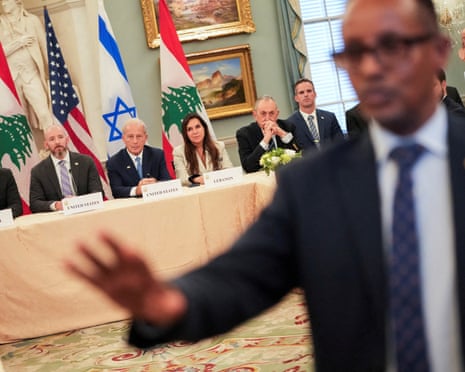 Delegations from the US, Israel and Lebanon meeting in Washington to implement a new ceasefire. Photograph: Nathan Howard/Reuters
theguardian.com
Delegations from the US, Israel and Lebanon meeting in Washington to implement a new ceasefire. Photograph: Nathan Howard/Reuters
theguardian.com
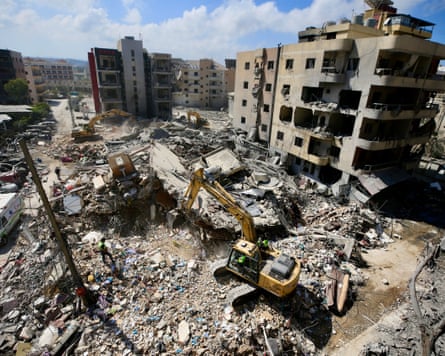 Rescuers work at the ruins of a residential building, after an Israeli airstrike in Tyre, southern Lebanon. Photograph: Xinhua/Shutterstock
theguardian.com
Rescuers work at the ruins of a residential building, after an Israeli airstrike in Tyre, southern Lebanon. Photograph: Xinhua/Shutterstock
theguardian.com
 Iranian strikes cause damage at Kuwait international airport – video
theguardian.com
Iranian strikes cause damage at Kuwait international airport – video
theguardian.com
Israel and Lebanon have agreed to implement a new ceasefire framework, with the US announcing terms that hinge on Hezbollah halting fire and pulling its fighters from south of the Litani river. According to The Guardian, the deal also sketches “pilot zones” where the Lebanese armed forces would have exclusive control, excluding non-state actors. The same morning the agreement was aired, Israel carried out multiple drone strikes in the Nabatieh area of southern Lebanon, underscoring how quickly paper commitments collide with battlefield routines.
The arrangement reprises a familiar sequence: Washington brokers a truce, Beirut is asked to enforce it, and Hezbollah—described as Iran-aligned—sits outside the room while being made the central condition. The joint statement released after talks in Washington did not specify if or when Israeli troops would withdraw from southern Lebanon, leaving one side’s obligations concrete and time-bound while the other’s are left to later “phased implementation.” The Guardian reports Israel occupies land along the border, and that a previous ceasefire in 2024 failed to deliver Hezbollah’s full disarmament even as strikes continued for months afterward.
That history matters because it shapes what each actor can safely promise. Lebanon’s government can endorse “exclusive control” zones, but its ability to impose them depends on the same armed balance that made Hezbollah a decisive player in the first place. Hezbollah, for its part, has said via AFP it would not accept a partial ceasefire, and it is not a party to the current talks—an omission that can simplify diplomacy while complicating enforcement.
The ceasefire is also being negotiated in the shadow of US-Iran talks that the Trump administration has tried to keep separate. The Guardian notes Trump said he wanted to decouple the Lebanon track from the Iran negotiations, while Tehran insists the conflicts are linked and has threatened to suspend talks with Washington over Israel’s Lebanon offensive. Lebanon’s government has said it will not allow Tehran to negotiate on its behalf, a statement that signals sovereignty but does not change the regional leverage Iran holds through allied militias.
The next test is not the wording of the joint statement but whether the promised “pilot zones” can be established on the ground while drones are still in the air. On Thursday morning, even as the ceasefire was being described as implemented, strikes were still being reported in southern Lebanon.