
Aditya Chakrabortty says Blair still dominates Labour politics
Guardian cites media coverage outstripping serving ministers, conference circuit keeps ex-leaders louder than officeholders
Images
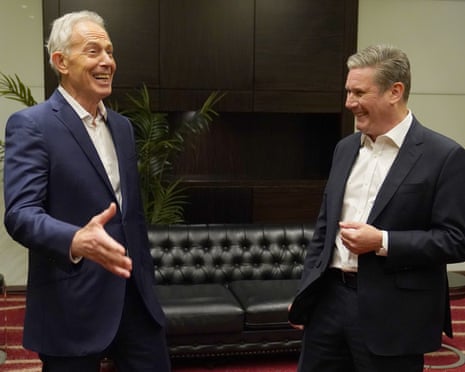 Tony Blair and Keir Starmer at the Institute for Global Change’s Future of Britain Conference in central London, 18 July 2023. Photograph: Stefan Rousseau/PA
theguardian.com
Tony Blair and Keir Starmer at the Institute for Global Change’s Future of Britain Conference in central London, 18 July 2023. Photograph: Stefan Rousseau/PA
theguardian.com
 Aditya Chakrabortty
theguardian.com
Aditya Chakrabortty
theguardian.com
Tony Blair and Keir Starmer shared a stage at the Institute for Global Change’s Future of Britain Conference in central London on 18 July 2023. Nearly three years later, Aditya Chakrabortty argues in The Guardian that Blair’s orbit still crowds out the people who actually hold office. He points to a recent burst of Westminster activity in which Peter Mandelson has been conspicuous, including a reported exchange with Pat McFadden, while Blair himself generated what Chakrabortty describes as “significant news” with an essay last week.
The column’s core evidence is not a single policy decision but a pattern of attention. The Guardian’s research department, Chakrabortty writes, found that Blair received three times the media coverage of Yvette Cooper and Shabana Mahmood combined in national newspapers early last week—despite Cooper and Mahmood being senior figures in the current government. In that framing, Blair’s influence is measured less by votes than by airtime: he gets more headlines than serving home and foreign secretaries, even as polls cited by Chakrabortty suggest the public rates him as less worth listening to than Boris Johnson.
Chakrabortty lists a cast of familiar names from the New Labour era who remain active in and around British politics: Harriet Harman, Gordon Brown, Jonathan Powell, Michael Barber, Liz Lloyd and Tim Allan. Alan Milburn, Blair’s former health secretary, has written a report on youth unemployment. Blair has weighed in on Iran—Chakrabortty says Blair backed intervention alongside Donald Trump—endorsed digital ID, and criticised net zero policy. The effect, in Chakrabortty’s telling, is that a leadership class that once promised modernisation now returns as a default setting, offering commentary and consultancy while newer figures operate inside a narrowing corridor.
The column also treats Blairism less as a coherent programme than as an institutional survival strategy. A former prime minister can speak with fewer constraints than ministers who must defend budgets, laws and administrative outcomes. Thinktanks and conference circuits can package positions as “ideas” without owning the delivery. Newspapers can cover a familiar protagonist while parliamentary committees and departmental work remain harder to turn into narrative.
Chakrabortty describes Labour under Starmer as backward-looking and reverential towards past figures, and he sketches a continuing factional struggle framed around who might define Labour’s next era. He notes a perceived leadership contest between Andy Burnham—praised by Blair as “an outstanding member of my government”—and Wes Streeting, described as a Blair admirer. Blair left office almost two decades ago, Chakrabortty observes, yet the party’s future is still discussed through the loyalties of that period.
More time has now passed since New Labour took office than the span between New Labour and Harold Wilson’s government, the column notes. Blair remains a regular fixture of British political conversation. Starmer’s government remains responsible for the bills.