
Iranian drones hit Kuwait international airport
One killed and more than 60 injured as Gulf spillover widens beyond Hormuz, Iran blames US interceptor error while Kuwait expels diplomats
Images
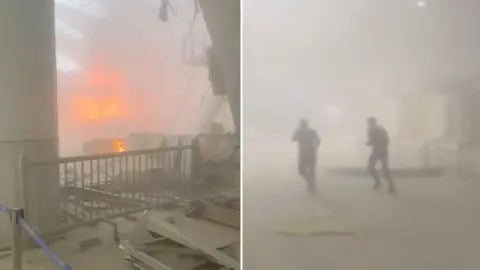
 Kuwait International Airport was hit by Iranian drones, the Kuwait military said
bbc.com
Kuwait International Airport was hit by Iranian drones, the Kuwait military said
bbc.com
 Kuwait International Airport was hit by Iranian drones, the Kuwait military said
bbc.com
Kuwait International Airport was hit by Iranian drones, the Kuwait military said
bbc.com
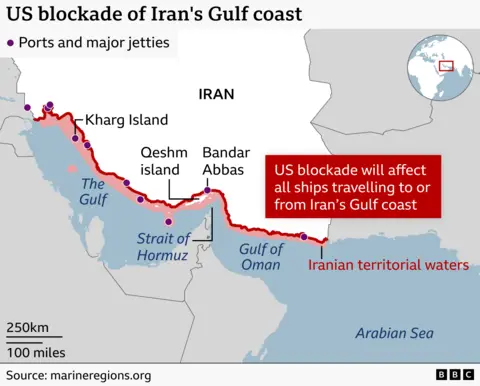 Map titled “US blockade of Iran’s Gulf coast” showing Iran’s southern coastline along the Persian Gulf and the Gulf of Oman. A red-shaded coastal strip labelled “Iranian territorial waters” runs from near Kharg Island in the northwest to the Gulf of Oman in the southeast, with a bold red line marking the blockade. Purple dots indicate “ports and major jetties” along the coast, including locations near Kharg Island, Qeshm Island, and Bandar Abbas. The Strait of Hormuz is labelled between the Gulf and the Gulf of Oman. A red annotation box states: “US blockade will affect all ships travelling to or from Iran’s Gulf coast.” A small inset map highlights the region’s location in the Middle East. A scale bar shows 250 km / 100 miles, and the source is marinerregions.org, with a BBC logo at the bottom.
bbc.com
Map titled “US blockade of Iran’s Gulf coast” showing Iran’s southern coastline along the Persian Gulf and the Gulf of Oman. A red-shaded coastal strip labelled “Iranian territorial waters” runs from near Kharg Island in the northwest to the Gulf of Oman in the southeast, with a bold red line marking the blockade. Purple dots indicate “ports and major jetties” along the coast, including locations near Kharg Island, Qeshm Island, and Bandar Abbas. The Strait of Hormuz is labelled between the Gulf and the Gulf of Oman. A red annotation box states: “US blockade will affect all ships travelling to or from Iran’s Gulf coast.” A small inset map highlights the region’s location in the Middle East. A scale bar shows 250 km / 100 miles, and the source is marinerregions.org, with a BBC logo at the bottom.
bbc.com
Iranian drones struck Kuwait’s international airport overnight, killing one person and injuring more than 60, according to the BBC. Kuwait said the passenger terminal was hit and diplomatic missions were damaged, and it ordered two Iranian diplomats to leave within 24 hours.
The airport strike widens a conflict that has mostly been fought through naval pressure and tit-for-tat attacks around the Strait of Hormuz into the kind of target Gulf governments have spent decades trying to insulate: civilian infrastructure that keeps trade, travel and expatriate labour moving. Kuwait hosts US forces and sits inside the dense web of bases, air defences and shipping routes that make the Gulf both strategically central and hard to firewall; when missiles and drones are traded across that network, the “front line” is wherever radar coverage, interceptors and flight paths overlap.
Responsibility is also being fought over in public. Kuwait’s defence ministry spokesman called the attack “criminal Iranian aggression”, while Iran’s Islamic Revolutionary Guard Corps denied responsibility and claimed the damage was caused by a US missile interceptor error, the BBC reports. US Central Command said Iran carried out a “deliberate, calculated and unjustified attack” and called the denial false. In practice, both sides have incentives to shape the narrative: Gulf states need to show control and deterrence; Tehran benefits from ambiguity that keeps retaliation politically costly; Washington wants to keep the focus on Iranian intent rather than on the risks and limits of interception over populated areas.
The strike also lands in the middle of stalled ceasefire talks. The BBC reports US and Iranian attacks continued as negotiations failed to advance over the weekend, with US media reporting President Donald Trump sought changes to draft terms related to Hormuz shipping and Iran’s highly enriched uranium. That sequencing matters because Hormuz is not just a military choke point but a billing mechanism: every extra day of uncertainty shows up as rerouting, delays and higher insurance costs that are paid far from the negotiating table.
Kuwait’s foreign ministry said it had summoned Iran’s charge d’affaires. Commercial flights were suspended while ambulances and hospitals absorbed the casualties from a terminal that is supposed to be a protected space.