
US disables tanker near Strait of Hormuz
Fresh missile and drone exchanges follow amid stalled talks, ceasefire language expands to Lebanon while shipping pays the first bill
Images
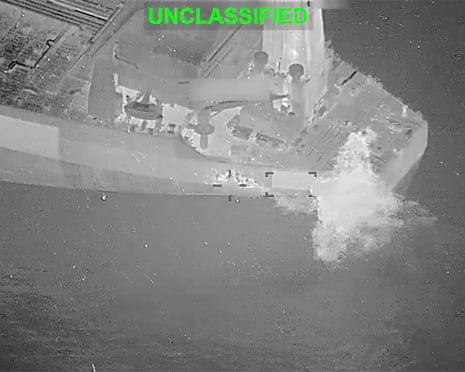 Screenshot from US Central Command of a Hellfire missile fired at a tanker attempting to break through the American blockade of the strait of Hormuz amid crisis in Iran. Photograph: U.S. Central Command
theguardian.com
Screenshot from US Central Command of a Hellfire missile fired at a tanker attempting to break through the American blockade of the strait of Hormuz amid crisis in Iran. Photograph: U.S. Central Command
theguardian.com
US and Iranian forces traded missiles and drones around the Strait of Hormuz as ceasefire talks stalled, according to The Guardian. The paper reports that US forces fired a Hellfire missile to disable a tanker attempting to break through an American blockade, while Iran’s Islamic Revolutionary Guard Corps said it attacked US targets in the Gulf region in response to US strikes on an Iranian island.
According to The Guardian, the tanker was the Botswana-flagged M/T Lexie, which the US military said ignored warnings over roughly a day before being hit in its engine area. The Guardian also reports that US forces struck sites on Iran’s Qeshm Island and later hit an Iranian military ground control station there, framing the actions as defensive moves amid threats to shipping. Iran’s IRGC claimed it had attacked the US Fifth Fleet headquarters in Bahrain with missiles and drones; US Central Command denied that the headquarters was hit.
Regional governments were left managing the debris field as much as the diplomacy. Kuwait’s military said its air defences intercepted missile and drone attacks and warned the public not to approach unidentified objects, while sirens sounded in Bahrain, The Guardian reports. Centcom said missiles aimed at Kuwait fell short or broke apart, and that missiles targeting Bahrain were intercepted by US and Bahraini forces.
The immediate contest is over maritime access and signalling, but the second-order effects land on commercial shipping and insurance pricing. The Guardian describes US forces also shooting down one-way attack drones launched toward civilian mariners transiting regional waters, turning the narrow passage into a place where tankers, drones and air-defence intercepts compete for the same attention. A ceasefire that depends on each side’s definition of “defensive” action can hold on paper while still producing nightly exchanges.
Diplomacy continued in parallel. The Guardian reports US Secretary of State Marco Rubio said a deal with Tehran was within reach and claimed Iran had agreed to negotiate parts of its nuclear programme previously off the table. At the same time, Iran indicated it would suspend talks in protest over Israel’s offensive in Lebanon, and Iranian foreign minister Abbas Araghchi said a ceasefire is a ceasefire “on all fronts”, tying the Gulf to Lebanon.
The Guardian’s account of the day’s events includes a disabled tanker, intercepted missiles over Kuwait, and competing statements about what hit what in Bahrain. The shipping lane remained open enough for warnings to be issued and debris to be collected.