
Abelardo de la Espriella wins Colombia first-round vote
Trump-admiring lawyer edges Iván Cepeda ahead of 21 June runoff, traditional conservative candidacy collapses to single digits
Images
 Supporters of Abelardo de la Espriella celebrate in Barranquilla, northern Colombia, on Sunday. The far-right lawyer has won the first round of the country’s presidential elections. Photograph: Ernesto Guzmán Jr/EPA
theguardian.com
Supporters of Abelardo de la Espriella celebrate in Barranquilla, northern Colombia, on Sunday. The far-right lawyer has won the first round of the country’s presidential elections. Photograph: Ernesto Guzmán Jr/EPA
theguardian.com
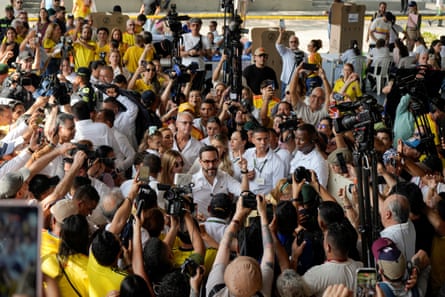 Abelardo de la Espriella gestures outside a polling station in Barranquilla on Sunday. He took 43.7% of the vote. Photograph: Charlie Cordero/Reuters
theguardian.com
Abelardo de la Espriella gestures outside a polling station in Barranquilla on Sunday. He took 43.7% of the vote. Photograph: Charlie Cordero/Reuters
theguardian.com
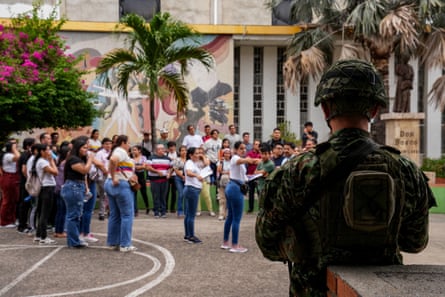 A soldier stands guard at a polling station in Cúcuta, a city on Colombia’s border with Venezuela. A resurgence of violence has been an issue in the presidential election. Photograph: Lucas Molet/Reuters
theguardian.com
A soldier stands guard at a polling station in Cúcuta, a city on Colombia’s border with Venezuela. A resurgence of violence has been an issue in the presidential election. Photograph: Lucas Molet/Reuters
theguardian.com
Colombian lawyer Abelardo de la Espriella took 43.7% in the first round of the country’s presidential election on Sunday, according to The Guardian, setting up a 21 June runoff against leftwing senator Iván Cepeda on 40.9%. Polls had shown Cepeda with a solid lead, making the result an upset in a race now decided by a margin The Guardian puts at roughly 670,000 votes. De la Espriella’s win also coincided with the collapse of a more established rightwing candidacy: senator Paloma Valencia finished on 6.9%.
The numbers point to a right that is consolidating around a candidate who is not the traditional conservative choice. Political scientist Yan Basset told The Guardian that Valencia’s late slide triggered tactical voting, pushing rightwing voters toward de la Espriella. Another analyst, Nadia Jimena Pérez Guevara, described a coalition of dissatisfaction: voters opposed to President Gustavo Petro, and voters simply fed up with politics, pooling behind a figure who campaigned amid multiple controversies.
De la Espriella has styled himself as an admirer of Donald Trump and other radical-right leaders in the region, and his platform offers fast, high-visibility fixes: he promised to end Colombia’s decades-long armed conflict within 90 days. That conflict has claimed nearly half a million lives, and violence has surged again to its highest levels since the 2016 peace agreement with most of the Revolutionary Armed Forces of Colombia (Farc), a backdrop that makes “total confrontation” messaging easier to sell. The Guardian reports that de la Espriella advocates military alliances with the US and Israel, a hard line against criminal groups, and the construction of mega-prisons.
Cepeda, by contrast, backs Petro’s “total peace” approach of negotiating the dismantling of criminal groups—an agenda that requires patience, enforcement credibility, and public tolerance for talks with actors many voters want punished rather than bargained with. On Monday morning after the vote, Cepeda challenged de la Espriella to a debate. In his Sunday-night speech, he described his opponent as a “misogynist” and “homophobe” and accused him of serving paramilitaries and drug traffickers, sharpening a runoff that will likely revolve around security and legitimacy rather than incremental policy.
Colombia has seen second-place candidates come back to win before, in 1998 and 2014, and The Guardian notes that roughly 3.6 million first-round votes went to neither finalist. The runoff will be decided by who can claim those voters without losing their own base.
Valencia spent months polling in second place and ended the night on single digits. De la Espriella now enters the final round as the candidate of the right, whether the traditional right wanted him or not.