
Israel expands ground push into southern Lebanon
Lebanon PM accuses scorched-earth policy as strikes kill at least 15, Washington talks continue while truce remains unobserved
Images
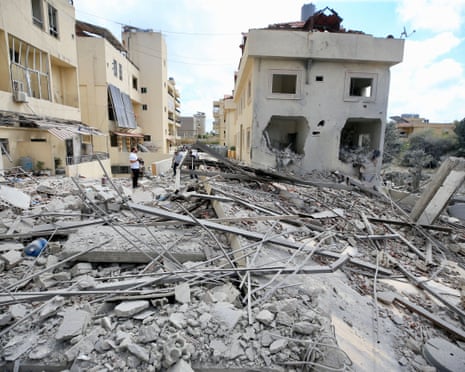 Residents checking destruction caused by Israeli airstrikes in Ansariyeh. Israeli airstrikes and drone attacks across southern Lebanon late Friday and into Saturday killed at least 15 people and wounded several others, according to Lebanon's Health Ministry. Photograph: Xinhua/Shutterstock
theguardian.com
Residents checking destruction caused by Israeli airstrikes in Ansariyeh. Israeli airstrikes and drone attacks across southern Lebanon late Friday and into Saturday killed at least 15 people and wounded several others, according to Lebanon's Health Ministry. Photograph: Xinhua/Shutterstock
theguardian.com
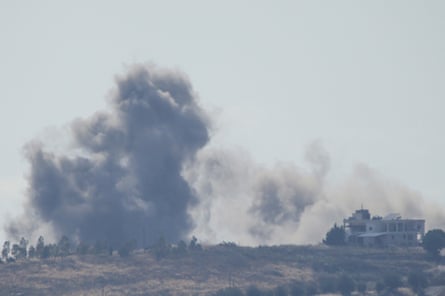 Smoke rises above the village of Kfar Tebnit in Nabatieh where the Israeli army carried out airstrikes on Saturday. Photograph: Anadolu/Getty Images
theguardian.com
Smoke rises above the village of Kfar Tebnit in Nabatieh where the Israeli army carried out airstrikes on Saturday. Photograph: Anadolu/Getty Images
theguardian.com
Israeli forces expanded ground operations in southern Lebanon over the weekend, with airstrikes and drone attacks killing at least 15 people and wounding several others, according to Lebanon’s health ministry as cited by The Guardian. Lebanon’s prime minister Nawaf Salam accused Israel of pursuing a “scorched-earth policy” and called for “a swift and real ceasefire,” while Israeli prime minister Benjamin Netanyahu said troops had advanced deeper into Lebanese territory. The Israeli military said its forces were pushing into additional areas as part of an effort to expand a “Forward Defense Line,” and The Guardian reported that Israeli troops had crossed the Litani river.
The weekend’s fighting sits awkwardly alongside diplomacy that continues to run in parallel. The Guardian reports that Israeli and Lebanese military delegations held security talks in Washington on Friday, with more US-brokered negotiations planned for next week. A US statement described “productive military-to-military discussions” but did not mention the truce that officially took effect in mid-April and, by both sides’ accounts, has not been observed.
On the ground, the mechanics of escalation are visible in the paperwork as much as the ordnance. Lebanon’s state-run National News Agency reported multiple Israeli attacks in the south, and the Israeli military issued fresh evacuation warnings for villages near Nabatieh and elsewhere. When evacuation maps are updated faster than ceasefire terms, civilians are left pricing the next strike with their own cars, mattresses, and family networks.
Hezbollah, for its part, said it launched multiple attacks into northern Israel on Saturday and claimed clashes with Israeli soldiers in southern Lebanon, according to The Guardian. Each side frames its actions as enforcement: Israel as pre-emption against Hezbollah infrastructure, Hezbollah as resistance aimed at pushing Israeli forces back. The result is that the “ceasefire” becomes a label applied after the fact to whatever level of violence the parties can sustain without triggering a wider intervention.
Reuters, cited by The Guardian, reported that the Israeli military said one of its soldiers had been killed in combat. There were also reports, The Guardian said, that Israeli forces captured a strategic castle in southern Lebanon, described as possibly the deepest incursion in decades.
In Washington, the delegations are scheduled to meet again next week. In southern Lebanon, evacuation warnings and overnight strikes are already setting the week’s terms.