
Chevron seeks operator role in Greek offshore gas block
HelleniQ deal would hand majority stake in Ionian Sea concession, Europe’s supply ambitions still depend on drilling permits
Images
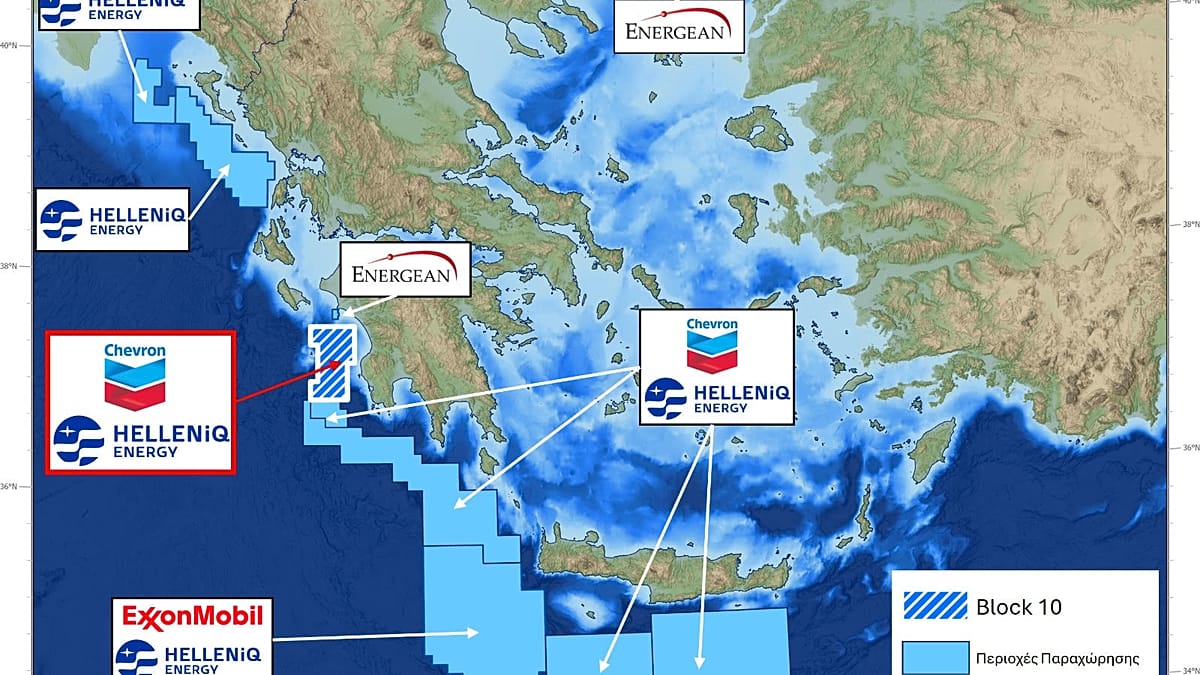 Chevron enters Greek offshore project as Europe seeks energy security
euronews.com
Chevron enters Greek offshore project as Europe seeks energy security
euronews.com
Chevron has applied to take a leading role in a Greek offshore gas exploration block in the Ionian Sea, according to Euronews, seeking to become operator and majority stakeholder alongside HelleniQ Energy. The request concerns Block 10, off the Gulf of Kyparissia, and would give Chevron a 70% stake if regulators approve the transfer of operatorship from HelleniQ to the US major.
The move lands in a Europe that is still trying to make long-term energy policy out of a crisis response. After Russia’s invasion of Ukraine, governments spent heavily to replace pipeline gas, secure LNG cargoes and subsidise households and industry. Those emergency measures reduced immediate shortages, but they did not create new domestic supply; they mostly reshuffled who pays and when. Offshore exploration, by contrast, is slow, capital-intensive and politically exposed—meaning it tends to proceed only when a company is confident it can hold the licence, finance drilling, and eventually sell the gas into a market that will still exist.
Euronews reports that Greece’s environment and energy ministry says the first two exploration phases in Block 10 have been completed, with a decision pending on a final phase that involves exploratory drilling. An 18-month extension of the second phase is under consideration to finish assessing data from 2D and 3D seismic surveys—an administrative detail that matters because exploration timelines often hinge on paperwork rather than geology. The same article notes that an ExxonMobil–HelleniQ Energy consortium recently decided not to proceed to the next phase in a separate “West of Crete” block, a reminder that not every licence turns into a well, and not every well turns into a field.
Chevron’s interest also underlines how the Eastern Mediterranean energy story is becoming a patchwork of selected bets rather than a single “new North Sea.” Euronews frames the region’s appeal partly in terms of Greece’s status as an EU and NATO member, and Chevron’s existing role operating the Aphrodite gas field offshore Cyprus. For Athens, the presence of a major operator can be presented as geopolitical validation as much as an investment decision; Greece’s minister is quoted describing Chevron’s participation as confirmation of Greece’s central role in energy agreements and investments.
For Europe’s energy consumers, the practical question is less about slogans of “diversification” and more about whether exploration results in commercially viable production, export routes, and contracts that can survive changing climate rules and price cycles. For governments, the temptation is to treat any new licence signing as a supply solution—long before a drillship arrives.
Chevron has asked to be the operator of Block 10. Greece’s regulators now have to decide whether a US major taking control of a Greek concession is an energy project, a strategic partnership, or both.