
Ebola outbreak in eastern DR Congo kills hospital staff
Suspected case count tops 900 as Ituri facilities lose doctors and nurses, Uganda reports travel-linked infections in Kampala
Images
 Dr Tibenderana Katho Blaise, who died of Ebola on Tuesday at Bunia medical centre, is buried. He was the fifth hospital staff member to die. Photograph: Gradel Muyisa Mumbere/Reuters
theguardian.com
Dr Tibenderana Katho Blaise, who died of Ebola on Tuesday at Bunia medical centre, is buried. He was the fifth hospital staff member to die. Photograph: Gradel Muyisa Mumbere/Reuters
theguardian.com
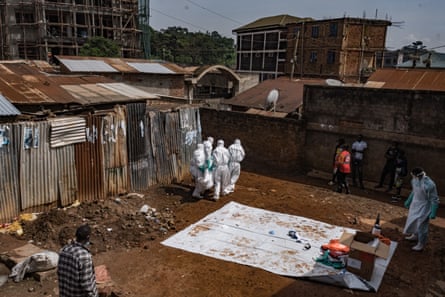 Ugandan Red Cross workers evacuate the body of a suspected Ebola victim in Kampala. There are now five Ebola cases linked to travellers from the DRC. Photograph: Badru Katumba/AFP/Getty
theguardian.com
Ugandan Red Cross workers evacuate the body of a suspected Ebola victim in Kampala. There are now five Ebola cases linked to travellers from the DRC. Photograph: Badru Katumba/AFP/Getty
theguardian.com
Ebola is killing frontline medical staff in eastern Democratic Republic of the Congo as the outbreak in Ituri province spreads through facilities that are meant to contain it. The Guardian reports that Dr Tibenderana Katho Blaise died on Tuesday at a medical centre in Bunia, two days after another doctor, Vladimir Maduali, died following oxygen therapy at an isolation centre in Rwampara, one of the worst-hit areas. At Bunia’s Evangelical medical centre, Blaise was the fifth hospital staff member to die from Ebola, and Maduali the fourth member of staff at his hospital to die in as many days.
The deaths are not being described as isolated tragedies but as an operational pattern: people tasked with triage, isolation and dead-body management are being infected in the course of routine work. At Mongbwalu hospital, about 70 km from Bunia, the medical director Richard Lokudu told the Guardian that five staff members are thought to have contracted Ebola since the outbreak was identified in June 2024, with three deaths and two more nurses seriously ill. Testing has not confirmed all infections or death tolls there, a detail that points to a familiar constraint in outbreak zones: the administrative picture lags the clinical reality.
The International Federation of Red Cross and Red Crescent Societies said three Congolese Red Cross volunteers died over 11 days after performing dead-body management activities as part of a humanitarian mission unrelated to Ebola. That distinction matters because it shows how quickly an outbreak can turn ordinary community support functions into high-risk exposure, especially when protective equipment, training, and supervision are uneven. The Congolese health ministry said there are more than 900 suspected cases, while Uganda has reported five cases linked to travellers from the DRC in Kampala, where Ugandan Red Cross workers evacuated the body of a suspected Ebola victim.
Cross-border spillover is often discussed as a question of surveillance and travel screening, but the reporting suggests a more basic mechanism: people move because they must—seeking work, care, or family—and the first systems to break are the ones that rely on scarce staff staying healthy. The head of the World Health Organization, Tedros Adhanom Ghebreyesus, is expected to visit the DRC to see the response on the ground, a high-level trip that typically signals both concern about trajectory and the need to unlock resources and coordination.
In Bunia, the outbreak’s most visible victims are not anonymous case numbers but the doctors and nurses meant to keep Ebola on the far side of an isolation ward. In Kampala, the body of a suspected victim still had to be moved by Red Cross workers, a reminder that containment work continues even when the border has already been crossed.