
Spain bans Francoist symbols
Franco-themed bars keep trading in Madrid and on motorways, bans meet busts merchandise and stamp-collecting routes
Images
 The Franco-themed Una Grande Libre bar-restaurant in Madrid’s Usera neighbourhood. Photograph: Abbas Asaria
theguardian.com
The Franco-themed Una Grande Libre bar-restaurant in Madrid’s Usera neighbourhood. Photograph: Abbas Asaria
theguardian.com
 Abbas Asaria
theguardian.com
Abbas Asaria
theguardian.com
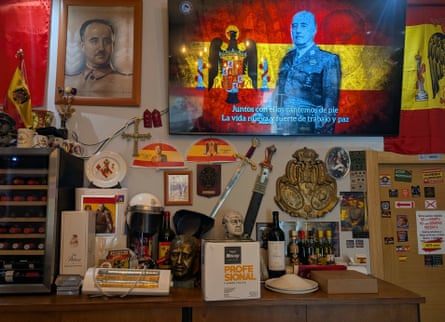 Interior of the Una Grande Libre bar-restaurant in Madrid. Photograph: Abbas Asaria
theguardian.com
Interior of the Una Grande Libre bar-restaurant in Madrid. Photograph: Abbas Asaria
theguardian.com
Spain bans Francoist symbols, roadside bars still sell dictator kitsch, enforcement collides with tourism economics and long memory wars
A bar-restaurant in Madrid’s Usera neighbourhood keeps a large portrait of Francisco Franco on its window and a stone bust inside, even as Spain has moved to ban Francoist symbols. In The Guardian, Abbas Asaria describes Una Grande Libre—named for Franco’s motto “one, great, free”—as playing the Falangist anthem Cara Al Sol several times a day, with staff answering the phone using the slogan “Arriba, España.”
The persistence is not limited to one address. According to the piece, other establishments such as El Cangrejo in Ciudad Real and Casa Pepe in Despeñaperros display familiar Franco-era emblems including the yoke and arrows of the Falange and the Eagle of San Juan, often framed in the red and yellow of the Spanish flag. Some of these venues sit beside motorways, positioned to catch drivers for whom a themed stop is less a political statement than a convenient meal, a photo, and a story to tell. One route, Ruta 36—named for the year of Franco’s coup—turns the motorway geography into a US-style pilgrimage, with some participants collecting stamps and being offered free meals once they complete the circuit.
The same article notes that Casa Pepe pairs food sales with a shop selling Franco memorabilia, from tote bags bearing the dictator’s face to tins of pimentón de la Vera designed with Francoist flags. That retail layer matters: a symbol on a wall is a provocation, but a symbol on a product is inventory, margins, and a customer base that can be counted at the till. When the state’s memory policy operates through bans, it still has to be executed through inspections, fines, and court processes—work that competes with other policing priorities and can be slowed by local discretion. Meanwhile, a private business only needs enough customers who either share the nostalgia, enjoy the transgression, or simply do not care.
Asaria also highlights how the politics of memory stretches across decades. Spain’s move in 2019 to relocate Franco’s remains—completed only after years of dispute—illustrated how symbolic acts can be delayed, litigated, and re-fought long after legislation is written. The new restrictions under Pedro Sánchez’s historical memory agenda aim to narrow the space for public glorification, but the venues described in the piece operate at street level, where enforcement is granular and where the line between “symbol,” “decoration,” and “merchandise” can become a practical argument.
Una Grande Libre sits near the centre of Madrid, not in a remote roadside niche, and The Guardian reports its owner is a Chinese immigrant known publicly as “el chino facha,” with the nickname written on wine bottles in the bar. The state may ban the symbols, but the businesses described are still open, still themed, and still selling.