
Shooting at Islamic Center of San Diego kills three
Authorities investigate hate-crime motive as two suspects die from apparent self-inflicted wounds, mosque security costs spread beyond one crime scene
Images
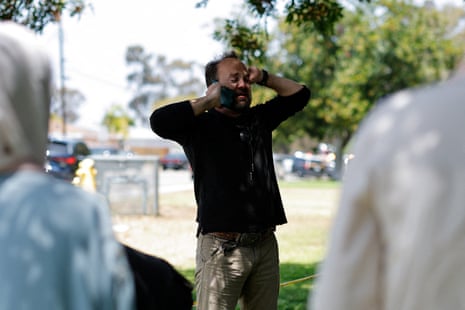 Members of the Muslim community at the scene of a shooting at the Islamic Center in San Diego, California. Photograph: Mike Blake/Reuters
theguardian.com
Members of the Muslim community at the scene of a shooting at the Islamic Center in San Diego, California. Photograph: Mike Blake/Reuters
theguardian.com
San Diego police say three people were killed in a shooting at the Islamic Center of San Diego in California, an attack that authorities are investigating as a hate crime. According to The Guardian, two suspects—aged 17 and 19—were found dead from apparent self-inflicted gunshot wounds, and one of those killed was a security guard at the mosque. The shooting happened shortly before midday prayer at the center in the Clairemont area, and officials said no children at the school on the premises were harmed.
The early official account leaves a familiar institutional shape: a high-profile act of violence, a rapid expansion of perimeter security, and then a long tail of investigation and policy signalling. The FBI said officers did not fire their weapons during the incident, suggesting the decisive events were over before a law-enforcement response could intervene, even as federal agencies moved quickly to establish a tip line and gather public information. San Diego’s mayor, Todd Gloria, held a press conference Monday afternoon, while California governor Gavin Newsom was briefed and the Governor’s Office of Emergency Services coordinated with local law enforcement, according to the paper.
The incident also produced immediate knock-on effects far from the crime scene. The New York Police Department said it was increasing deployments to mosques across New York City as a precaution, despite stating there was no known connection to New York or specific threats there. That pattern—treating a single event as a trigger for wider protective posture—can reassure congregations while also normalising a permanent surge model in which visible policing follows headlines rather than locally verified risk.
For religious institutions, the operational reality is that security costs arrive regardless of motive or final charging decision. The Islamic Center of San Diego is described by The Guardian as the largest mosque in San Diego County; larger facilities tend to have schools, regular public footfall, and predictable gathering times, all of which make them easier to protect with staff and procedures but also harder to secure without turning community spaces into controlled sites. A reunification center was set up for families, and victims were treated at Sharp Memorial hospital, details that underline how quickly a place of worship can become a multi-agency incident scene.
Investigators have not yet laid out a public narrative of how the suspects reached the site, what they carried, or what planning preceded the attack. For now, authorities are left with a crime scene, a hate-crime inquiry, and a set of precautionary deployments in other cities.
The shooting took place shortly before midday prayer. The NYPD said there was no known connection to New York City as it increased patrols around mosques.