
Putin visits Beijing days after Trump summit
Xi Jinping hosts rival powers in rapid succession, China’s Russian energy trade grows as other shipping lanes destabilise
Images
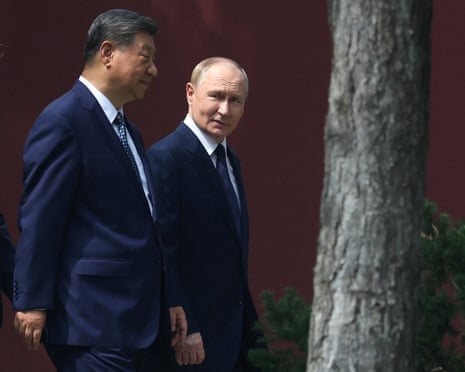 China’s leader Xi Jinping and Russian President Vladimir Putin walk at the personal residence of the Chinese leader Zhongnanhai in Beijing in 2025. Photograph: Alexander Kazakov/Reuters
theguardian.com
China’s leader Xi Jinping and Russian President Vladimir Putin walk at the personal residence of the Chinese leader Zhongnanhai in Beijing in 2025. Photograph: Alexander Kazakov/Reuters
theguardian.com
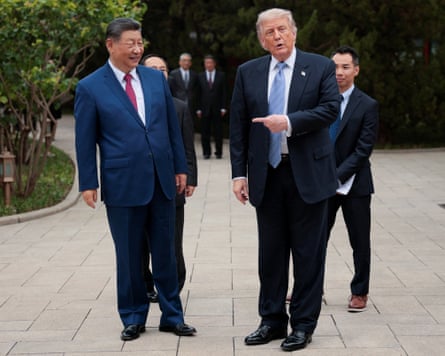 Donald Trump and Xi Jinping after a visit to the Zhongnanhai garden in Beijing. Photograph: Evan Vucci/Reuters
theguardian.com
Donald Trump and Xi Jinping after a visit to the Zhongnanhai garden in Beijing. Photograph: Evan Vucci/Reuters
theguardian.com
Xi Jinping is preparing to host Vladimir Putin in Beijing just days after welcoming Donald Trump, an unusually tight sequence that Chinese state-linked outlets have presented as proof that China is now a central venue for great-power diplomacy. The Guardian reports that Xi and Putin exchanged congratulatory letters ahead of the visit, which is framed around the anniversary of the China–Russia strategic partnership.
The timing matters because China’s relationship with Russia has deepened as the war in Ukraine has continued and as energy routes elsewhere have become less reliable. According to the Guardian, China buys more than one-quarter of Russia’s exports and has purchased large volumes of Russian crude oil since the full-scale invasion began, providing Moscow with revenue while giving Beijing a supply cushion. The same reporting notes that China’s energy security has become more salient after the crisis in the Middle East disrupted oil shipping through the Strait of Hormuz.
Trump’s Beijing talks, by contrast, focused on trade, Taiwan and the Middle East, with Ukraine barely appearing in official readouts from either side. That omission leaves space for Beijing to separate files: one set of conversations with Washington about tariffs, shipping lanes and arms sales, and another with Moscow about longer-term supply deals and strategic alignment. Analysts cited by the Guardian suggest Taiwan may sit in the background of the Xi–Putin meeting, not as a headline item but as a planning assumption: energy contracts and diplomatic choreography that would matter most if the region’s security picture worsens.
For Europe, the practical question is less what is said in public and more what is signed in private: commodity flows, financial channels and logistics that keep a sanctioned war economy functioning. Beijing can call itself neutral while still being the buyer that clears Russia’s export bottleneck.
Putin is expected in Beijing for meetings over two days. Four days earlier, Trump left without saying whether he would approve a major US weapons deal to Taiwan.