
Timmy the humpback whale is found dead near Anholt
Danish agency confirms identity after retrieving tracking device, costly private rescue ends without necropsy plans
Images
 Timmy the whale had been transported in a water-filled barge, which was pulled by a tugboat from Wismar Bay in Germany to the Danish coast. Photograph: Action Press/Shutterstock
theguardian.com
Timmy the whale had been transported in a water-filled barge, which was pulled by a tugboat from Wismar Bay in Germany to the Danish coast. Photograph: Action Press/Shutterstock
theguardian.com
 bbc.com
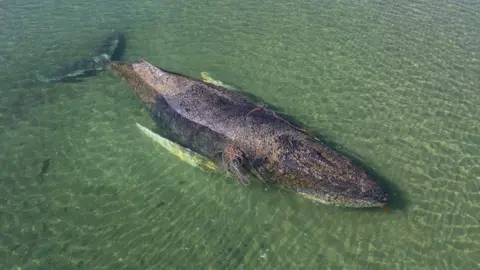 EPA/Sea Shepherd The partially submerged whale shown stranded on a shallow sandbank in Lubeck Bay on 23 March
bbc.com
EPA/Sea Shepherd The partially submerged whale shown stranded on a shallow sandbank in Lubeck Bay on 23 March
bbc.com
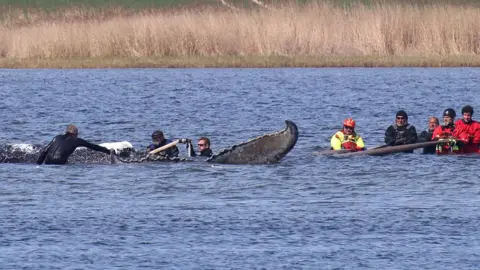 The whale was coaxed into swimming into the barge which then took it out to sea
bbc.com
The whale was coaxed into swimming into the barge which then took it out to sea
bbc.com
A humpback whale nicknamed “Timmy” was found dead near the Danish island of Anholt two weeks after being hauled out of Germany’s Baltic shallows in a privately funded rescue. Denmark’s Environmental Protection Agency confirmed the identity on Saturday after retrieving the tracking device attached during the operation, according to the Guardian and BBC. The animal had been stranded repeatedly off Germany’s coast since late March, and was finally moved in early May aboard a water-filled barge to deeper water.
The case became a public argument about what “rescue” means when an animal is already failing. The International Whaling Commission criticised the effort as inadvisable, the Guardian reports, and experts at the Oceanographic Museum in Stralsund warned the whale was severely compromised after weeks in low-salinity Baltic water. Wildlife groups said the calf had suffered skin damage and was at risk of drowning from weakness; parts of its mouth were believed to have been caught in a fishing net. Even so, the operation went ahead after two German entrepreneurs offered to pay to free the whale, turning a technical decision into a national spectacle.
That spectacle created its own chain of responsibility. Once a high-profile intervention is launched, agencies and ministers face pressure to treat the outcome as proof of competence rather than as an uncertain bet. Mecklenburg-Vorpommern’s environment minister praised the operation as a success after the whale was released, the BBC reports, even though the tracker intended to monitor its progress was not working, according to the Guardian. When Timmy was later found dead, the co-financiers distanced themselves from how the release was conducted and called for consequences for the owner, operators and crew of the vessels involved.
The cross-border aftermath is notably administrative: Denmark says it has no concrete plans to remove the carcass or conduct a necropsy, and does not currently consider it a problem in the area. The agency warned people not to approach the whale because it may carry diseases transmissible to humans, and because decomposition can build up internal gas that can cause an “explosion,” the BBC reports. In practice, the final public-health message is clearer than the earlier decision-making that moved a weak animal from one jurisdiction to another.
Timmy was released into the North Sea on 2 May, and was found dead near Anholt about two weeks later. Danish authorities retrieved the tracking device, but said there were no concrete plans for further examination of the carcass.