
Bundibugyo Ebola kills at least 65 in eastern DR Congo
Suspected cases reported near mining towns and border crossings, outbreak response lacks a licensed vaccine
Images
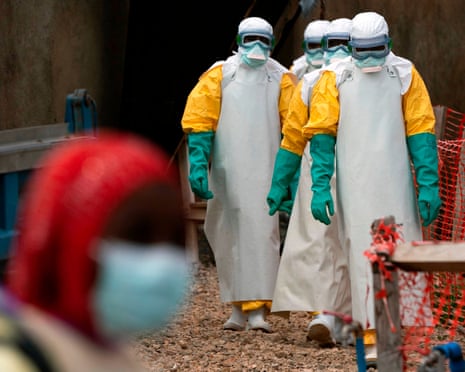 Health workers in protective clothing at an Ebola treatment centre in Beni in eastern DRC during an outbreak of the disease in 2019. Photograph: Jérôme Delay/AP Photo
theguardian.com
Health workers in protective clothing at an Ebola treatment centre in Beni in eastern DRC during an outbreak of the disease in 2019. Photograph: Jérôme Delay/AP Photo
theguardian.com
At least 65 people have died in a new Ebola outbreak in eastern Democratic Republic of the Congo, with 246 suspected cases reported in Ituri province, according to The Guardian. Congolese authorities say laboratory testing detected Ebola in 13 of 20 samples. The same reporting says the outbreak involves the Bundibugyo strain, for which there is no licensed vaccine.
The geography makes containment harder than the case numbers suggest. Ituri borders both Uganda and South Sudan, and the affected area includes mining towns where workers and traders move frequently between sites, settlements, and across borders. The Guardian reports that Uganda’s health ministry has confirmed an Ebola outbreak, and that a 59-year-old man died in a Kampala hospital after travelling from the DRC. For health agencies, the problem is less the existence of a border than the volume and informality of daily crossings—movement that is economically necessary and administratively difficult to map in real time.
Africa CDC has warned about the risk of further spread and planned an urgent meeting with authorities from the DRC, Uganda, South Sudan, the World Health Organization and pharmaceutical companies, the Guardian reports. The Bundibugyo strain changes the playbook: previous DRC outbreaks have often involved the Zaire strain, for which vaccines exist, but this time officials cannot lean on a licensed shot as the default tool. That shifts more of the burden onto case finding, isolation capacity, protective equipment, safe burial practices and local trust—tasks that become expensive and politically fraught when clinics are sparse and transport is slow.
The outbreak also lands in a country that has lived with Ebola long enough for fatigue to become part of the public-health landscape. The Guardian notes that the DRC has experienced 16 Ebola outbreaks since the virus was first identified there in 1976. Dr Michael Head of the University of Southampton told the newspaper that repeated spillovers are linked to close human contact with animal reservoirs, population movement between rural and urban areas, and the region’s rainforest environment. In West Africa’s 2014–2016 epidemic, the toll reached an estimated 28,000 cases and 11,000 deaths—an example health officials still cite when early clusters are allowed to become a regional event.
In Ituri, the Guardian reports cases have been concentrated in the Mongwalu and Rwampara health zones, with suspected cases also reported around Bunia. The difference between a local outbreak and an international emergency may come down to whether those health zones can keep patients from travelling before symptoms force them into care.