
US charges Iraqi man over alleged transatlantic attack campaign
Justice department links suspect to Kata’ib Hezbollah and IRGC networks, courtroom proof must match the map-and-propaganda narrative
Images
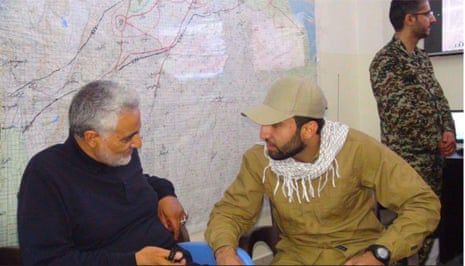 This photo from a criminal complaint unsealed Friday shows Mohammad Baqer Saad Dawood al-Saadi (right) with Qassem Suleimani, a former Iranian commander. Photograph: Southern district of New York/AP
theguardian.com
This photo from a criminal complaint unsealed Friday shows Mohammad Baqer Saad Dawood al-Saadi (right) with Qassem Suleimani, a former Iranian commander. Photograph: Southern district of New York/AP
theguardian.com
US charges Iraqi man over alleged transatlantic attack campaign, justice department links suspect to Kata’ib Hezbollah and IRGC networks, European arsons and stabbings arrive as hybrid-warfare claims remain unproven
US prosecutors have charged an Iraqi national, Mohammad Baqer Saad Dawood al-Saadi, with terrorism-related offences tied to an alleged role in a string of attacks and attempted attacks in the United States and Europe, according to The Guardian. The US justice department says al-Saadi was transferred into US custody overseas and brought to New York, where he appeared in federal court in Manhattan. The complaint lists six charges, including conspiracy to provide material support to foreign terrorist organisations, conspiracy to bomb a place of public use, and attempted destruction of property by fire or explosives.
The Guardian reports that US authorities describe al-Saadi as an operative and “commander” linked to Kata’ib Hezbollah and Iran’s Islamic Revolutionary Guard Corps, both designated by the US as terrorist organisations. The complaint alleges personal proximity to senior figures: photographs are said to show al-Saadi with Qassem Suleimani, the IRGC commander killed in a US strike in 2020, and the filing also describes him as close to Abu Mahdi al‑Muhandis, a Kata’ib Hezbollah leader killed alongside Suleimani.
The case is being presented as more than a single plot. The Guardian says the justice department ties al-Saadi to nearly 20 alleged attacks and attempted attacks, with a focus on Jewish community centres, synagogues and charities. One alleged incident cited is a firebombing at a New York Mellon bank in Amsterdam in March; prosecutors say a propaganda video posted the next day showed planning details including maps and carried a warning urging people in the European Union to distance themselves from “American and Zionist interests.” The complaint also alleges involvement in an arson attack on a synagogue in Skopje and in the stabbing of two Jewish men in London, including a dual US‑British citizen.
Several of the European incidents were claimed in the name of Harakat Ashab al‑Yamin al‑Islamia, a group The Guardian describes as previously unknown. Analysts and security officials cited in the report say there is no direct proof of Iran’s involvement, while also arguing that the pattern and messaging resemble a campaign designed to intimidate and destabilise—an interpretation that has gained political traction in the UK amid heightened concern over antisemitic violence.
For US authorities, the arrest shifts the story from threat assessment to courtroom proof. The complaint’s narrative relies heavily on networks, affiliations and propaganda material, including a July 2020 social-media post attributed to al‑Saadi calling for revenge after Suleimani’s killing. The burden now is to translate that material into evidence that can survive cross-examination, while European investigators and US agencies sort out which attacks were centrally directed and which were inspired, opportunistic, or falsely claimed.
Al‑Saadi was brought to Manhattan to answer charges that span continents. The justice department’s filing says the alleged campaign targeted public sites; the first hearings took place in a federal courtroom built for paper trails.