
Rajan Menon: Putin seeks ceasefire cover for Victory Day parade
Guardian column says Ukrainian drones push war into Russian cities, economic slowdown meets 2.2% unemployment
Images
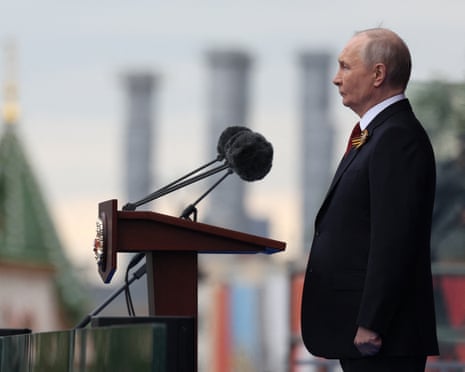 Vladimir Putin at the Victory Day military parade in Red Square, Moscow, 9 May 2026. Photograph: Vyacheslav Prokofyev/AFP/Getty Images
theguardian.com
Vladimir Putin at the Victory Day military parade in Red Square, Moscow, 9 May 2026. Photograph: Vyacheslav Prokofyev/AFP/Getty Images
theguardian.com
 Rajan Menon
theguardian.com
Rajan Menon
theguardian.com
Rajan Menon puts a number on Russia’s war fatigue: four years after the invasion of Ukraine, he writes in the Guardian, the front is largely stalled even as Ukrainian drones and missiles keep reaching deep into Russian territory.
According to Menon, Vladimir Putin appeared at the 9 May Victory Day parade in Moscow after proposing a three-day ceasefire during a 29 April phone call with Donald Trump—an offer framed as a way to avoid a strike on Red Square. Menon says Volodymyr Zelenskyy accepted at Trump’s urging because the package included a prisoner exchange, while Putin’s decree singled out Red Square rather than shielding Russia as a whole.
The column’s broader claim is that the war’s costs are no longer confined to the battlefield. Menon lists repeated strikes and fires at refineries, disruptions at airports, and attacks on oil-loading ports, alongside a parade scaled back for security reasons. He also points to pressure inside the Russian economy: labour pulled into the army and the defence industry, unemployment at 2.2% in March 2026, and small businesses squeezed by tax increases and competition for workers.
The growth figures he cites sketch a deceleration that looks less like wartime mobilisation paying for itself and more like a bill coming due: growth falling from 4.9% in 2024 to 1% in 2025, expected to stay around that level in 2026, with GDP shrinking year-on-year in the first quarter of 2026. Menon adds a warning from Russia’s Chamber of Commerce and Industry that nearly two-thirds of small businesses did not turn a profit in the first quarter.
On the military side, Menon argues that Ukraine’s drone warfare has changed what is feasible along a roughly 900-mile frontline. He describes Russian commanders struggling to mass armoured and mechanised units without being spotted, shifting instead to small infiltration groups—tactics that, he says, are then targeted by Ukrainian drones. Alongside this, he notes criticism from pro-war military bloggers of mismanagement and at least one warning that Russia could lose.
Menon’s most arresting figure is his estimate of 1.3 million Russian troops dead or wounded. Put next to the practical details—airport closures, delayed flights, refineries burning, and a parade reduced in scale—the argument is that the war is now visible to ordinary Russians in ways that propaganda cannot fully schedule around.
Putin still stood on Red Square on 9 May, but Menon’s account suggests the Kremlin is increasingly negotiating not just with Kyiv and foreign leaders, but with the country’s own capacity to absorb disruption.