
UK signs Council of Europe declaration backing third-country return hubs
Labour seeks offshore option for rejected asylum seekers while ECHR court limits come under pressure, seven-page text tests how far deportation policy can be externalised
Images
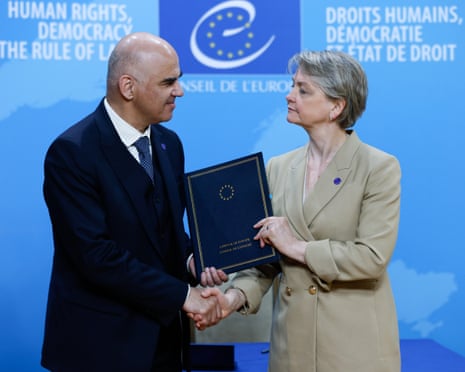 Yvette Cooper, the UK foreign secretary, and Alain Berset, the secretary general of the Council of Europe, attending the document signing ceremony in Chişinău, Moldova, on Friday. Photograph: Dumitru Doru/EPA
theguardian.com
Yvette Cooper, the UK foreign secretary, and Alain Berset, the secretary general of the Council of Europe, attending the document signing ceremony in Chişinău, Moldova, on Friday. Photograph: Dumitru Doru/EPA
theguardian.com
The UK has signed a Council of Europe political declaration backing the use of third-country “return hubs” and other offshore processing models for people who have no right to stay, joining 45 other European states in endorsing the approach. The Guardian reports the signing took place at a high-level meeting in Chişinău, Moldova, with the UK represented by foreign secretary Yvette Cooper alongside Council of Europe secretary general Alain Berset. The document frames border control as an “undeniable sovereign right” and invites governments to “deter” irregular migration through new forms of cooperation.
The declaration matters less as law than as coordination. The Council of Europe oversees the European Convention on Human Rights, and the text explicitly grapples with how deportations collide with court challenges under the convention, particularly articles 3 and 8 on protection from inhuman treatment and the right to family life. Ministers in several countries have argued these provisions are used to block removals; the declaration says “caution” should be exercised when assessing whether expulsion to a non-member state breaches article 3 obligations, and it seeks to narrow the space for courts to intervene.
For the UK, the declaration lines up with an operational problem: what to do with rejected asylum seekers when domestic detention capacity, legal appeals, and removal logistics move at different speeds. The Guardian says the UK is seeking a deal with an unnamed third country to establish detention or processing hubs for rejected asylum seekers, modelled on Italy’s agreement with Albania. In that case, the hubs were initially intended for people from “safe countries” while claims were processed, but Italy’s government under Giorgia Meloni has also used them to hold people for deportation after claims were rejected.
The shift pushes costs and controversy outward. Offshore hubs require a host country willing to accept legal, security and reputational risk in exchange for payments and political favour, while the sending country gains a visible enforcement tool without having to expand contested facilities at home. The same structure also creates a new set of intermediaries — contractors, transport providers, and legal frameworks designed to keep responsibility at arm’s length.
The politics in London are explicit. The Guardian notes the ECHR has become a major issue, with Keir Starmer supporting changes to the convention while the Conservatives and Reform UK have pledged to leave it. Cooper said Labour was “reforming the ECHR with European partners” to strengthen relationships abroad and national interests at home, language that treats the convention as a negotiable instrument rather than a fixed constraint.
Madeleine Sumption of Oxford’s Migration Observatory told the Guardian it is unclear how much impact the declaration will have on immigration cases.
The document is seven pages long, and it was signed by all 46 Council of Europe members.