
Iran claims joint Hormuz plan with Oman
Tehran floats tolls and nationality screening via new strait authority, rival UK French proposal courts Muscat
Images
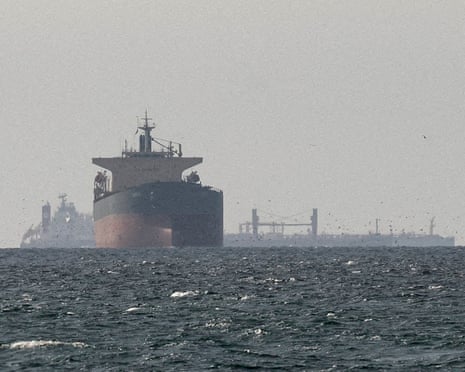 Commercial shipping can be seen near the strait of Hormuz close to the border with Oman’s Musandam governorate in March. Photograph: Reuters
theguardian.com
Commercial shipping can be seen near the strait of Hormuz close to the border with Oman’s Musandam governorate in March. Photograph: Reuters
theguardian.com
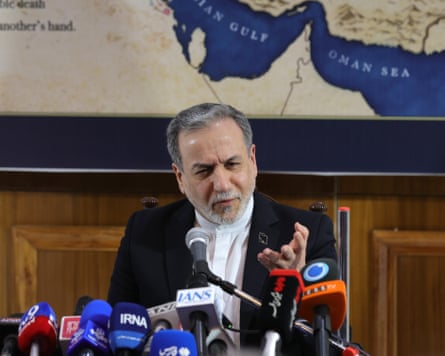 Iran’s foreign minister, Abbas Araghchi, said the strait of Hormuz was an exclusively Omani-Iranian waterway. Photograph: Rajat Gupta/EPA
theguardian.com
Iran’s foreign minister, Abbas Araghchi, said the strait of Hormuz was an exclusively Omani-Iranian waterway. Photograph: Rajat Gupta/EPA
theguardian.com
 Donald Trump, pictured with Xi Jinping in Beijing, claimed China agreed there could be no tolls or restrictions. Photograph: White House Press Office/APAImages/Shutterstock
theguardian.com
Donald Trump, pictured with Xi Jinping in Beijing, claimed China agreed there could be no tolls or restrictions. Photograph: White House Press Office/APAImages/Shutterstock
theguardian.com
Iran claims it is coordinating with Oman on a new regime for the Strait of Hormuz, including fees for commercial ships and a requirement to pay through an Iranian government body, according to The Guardian. The proposal would formalise Tehran’s leverage over a chokepoint that normally carries a large share of global seaborne oil, while the strait has remained effectively closed for weeks amid the wider conflict.
The Guardian reports that Iran has created a new agency—the Persian Gulf Strait Authority—to administer the system, framing Hormuz as an exclusively Iranian-Omani waterway. Iranian officials argue the legal baseline is not automatic “transit passage” but more restrictive rules that can be tightened when coastal states face threats, a position complicated by Iran having signed but not ratified the UN Convention on the Law of the Sea. Western diplomats cited by the paper call the toll concept unlawful, and point to a further practical problem: Iran’s reported demand that ships set up rial accounts could collide with sanctions restrictions on payments that might benefit the Islamic Revolutionary Guard Corps.
Oman’s role is the hinge. Muscat sits next to the narrowest point of the strait by the Omani exclave of Musandam, and has long balanced security ties with the US and Gulf monarchies against a working relationship with Tehran. The Guardian says Oman has not publicly endorsed the fee plan, even as Iranian leaders present coordination as a fait accompli. That ambiguity leaves shipping and insurers pricing political risk rather than published rules: a toll schedule, a nationality screen, or a discretionary permit system all create different incentives for rerouting, for flags of convenience, and for private security arrangements at sea.
A rival approach is also taking shape. The Guardian reports that France and the UK have prepared an alternative plan based on freedom of navigation and presented it to Oman, with support from most Gulf states, alongside high-level visits to Muscat by British officials and the head of the International Maritime Organization. The standoff is therefore not only about reopening a waterway; it is about who gets to write the operating manual for it, and whether the price of passage is paid in dollars, rial accounts, or political concessions.
Iran’s new strait authority was established in early May, The Guardian reports. The tolling system it is meant to run still lacks any public Omani sign-off.