
Iran seizes floating armoury ship near UAE
UKMTO says vessel bound for Iranian waters, anti-piracy logistics becomes another lever in Hormuz standoff
Images
 bbc.com
 Getty Images A satellite image of the Strait of Hormuz with BBC Verify branding
bbc.com
Getty Images A satellite image of the Strait of Hormuz with BBC Verify branding
bbc.com
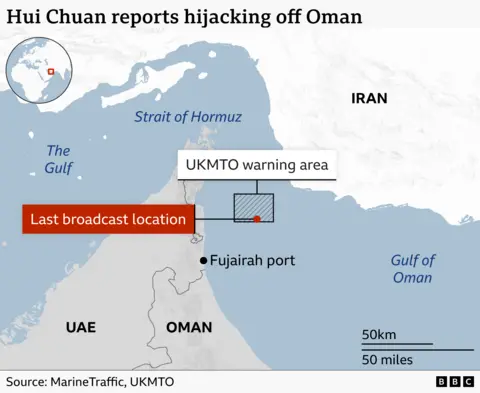 A map showing Hui Chuan's last broadcast location and the UKMTO warning area
bbc.com
A map showing Hui Chuan's last broadcast location and the UKMTO warning area
bbc.com
Iranian military personnel have seized a vessel described as a “floating armoury” in waters near the United Arab Emirates, according to the BBC, citing the maritime risk management company Vanguard. The UK Maritime Trade Operations (UKMTO) office said the ship is now “bound for Iranian territorial waters.” Ship-tracking data reviewed by the BBC placed the vessel—identified by Vanguard as the Honduras-flagged Hui Chuan—last broadcasting its location north-east of Fujairah in the UAE.
The episode lands in a corridor where paperwork and coercion now compete with naval power. Floating armouries exist to solve a practical problem: private security teams protecting merchant ships from piracy need somewhere to store and transfer weapons without repeatedly entering ports and triggering local arms rules. According to the BBC, such vessels have operated in the Red Sea, the Gulf of Aden and the Gulf of Oman, functioning as offshore depots where guards collect and drop off weapons and ammunition. That arrangement depends on a thin layer of toleration by coastal states; once a state decides the same ship is a bargaining chip, the business model turns into an invitation.
UKMTO’s alert also shows how quickly a commercial incident becomes a state-to-state signal. The BBC notes it cannot confirm what was on board the Hui Chuan or who used it, but the claim that it stored weapons for security firms is enough to change the legal and diplomatic framing: from merchant shipping to arms control, from insurance risk to national security. The seizure follows another maritime incident off Oman the same day, when an Indian-flagged vessel, Haji Ali, was attacked and later sank after what Vanguard described as a suspected explosion believed to have been caused by a drone or missile. Indian officials said all Indian crew were safe after rescue by Omani authorities, while India’s foreign ministry called the attack “unacceptable.”
The churn of seizures, attacks and rescues is increasingly being discussed alongside energy diplomacy at the highest level. The BBC reports that the Strait of Hormuz was raised in talks between US President Donald Trump and China’s President Xi Jinping in Beijing, with the White House saying Xi opposed “militarization” of the strait and both sides agreeing it must remain open for energy flows. That is a neat line for communiqués, but shipping in the region is already being shaped by who can be boarded, who can be escorted, and which routes insurers will still price.
MarineTraffic data cited by the BBC shows the Hui Chuan had spent weeks off the north-east coasts of Oman and the UAE. It is now, according to UKMTO, headed toward Iranian waters.