
MSF hospital in South Sudan left bombed and looted
Lankien facility served as only secondary care in region, oxygen concentrators and power panels torn out after strike
Images
 Charred medical supplies in the hospital’s burnt-out former cold-chain room. Photograph: Florence Miettaux/The Guardian
theguardian.com
Charred medical supplies in the hospital’s burnt-out former cold-chain room. Photograph: Florence Miettaux/The Guardian
theguardian.com
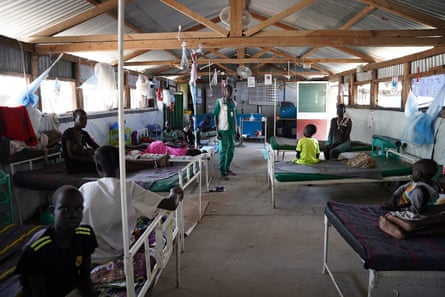 The inpatient ward of the MSF hospital in Lankien before the bombing. The 80-bed facility offered life-saving care including maternal and paediatric services. Photograph: Nasir Ghafoor/MSF
theguardian.com
The inpatient ward of the MSF hospital in Lankien before the bombing. The 80-bed facility offered life-saving care including maternal and paediatric services. Photograph: Nasir Ghafoor/MSF
theguardian.com
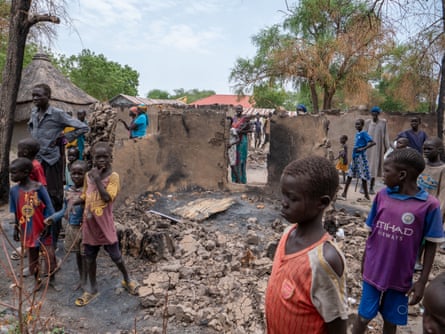 Destruction around Nyriol county’s headquarters. Photograph: Florence Miettaux
theguardian.com
Destruction around Nyriol county’s headquarters. Photograph: Florence Miettaux
theguardian.com
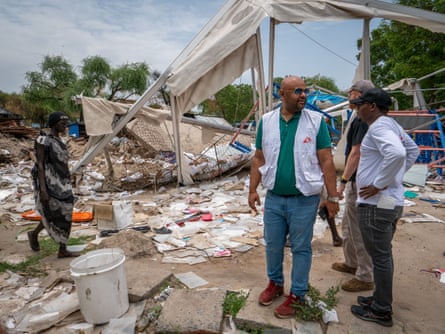 ‘It’s all gone’, says Yashovardhan, centre, as the team stand amid the wreckage of the medical warehouse. Photograph: Florence Miettaux/The Guardian
theguardian.com
‘It’s all gone’, says Yashovardhan, centre, as the team stand amid the wreckage of the medical warehouse. Photograph: Florence Miettaux/The Guardian
theguardian.com
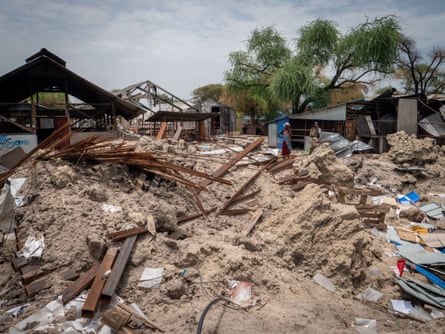 Women stand near the crater left by the bomb, and remains of the medical warehouse that once contained critical supplies. Photograph: Florence Miettaux/The Guardian
theguardian.com
Women stand near the crater left by the bomb, and remains of the medical warehouse that once contained critical supplies. Photograph: Florence Miettaux/The Guardian
theguardian.com
An 80-bed Médecins Sans Frontières hospital in Lankien in South Sudan’s Jonglei state went from a working facility to a bombed-out shell within days, The Guardian reports. MSF says a government plane dropped a bomb on the hospital on 3 February, after which the site was burned and looted amid escalating fighting.
The attack lands in a region where the health system is not a buffer against violence but one of its first casualties. The Guardian describes the Lankien hospital as the only secondary healthcare centre for the area, serving an estimated 250,000 people with maternal and paediatric care, treatment for chronic disease, severe malnutrition and malaria, and services for survivors of sexual violence. When such a facility is hit, the loss is not only beds and walls; it is the disappearance of the only place that can stabilise a complicated birth, treat a severe infection, or keep a malnourished child alive.
The wider conflict has given armed actors reasons to treat clinics as spoils. The fighting in Jonglei is described as between the South Sudan People’s Defence Forces, loyal to President Salva Kiir, and the Sudan People’s Liberation Movement In Opposition, led by suspended vice-president Riek Machar. The UN high commissioner for human rights, Volker Türk, said in late February that civilians were suffering from indiscriminate attacks including aerial bombardments, killings, abductions and sexual violence, and that troops on both sides had shown near total disregard for civilian protection.
Displacement turns healthcare into a moving target. The Guardian reports that since December 2025 more than 304,000 people in Jonglei have been displaced by fighting, a scale that overwhelms any fixed service network even when it is intact. MSF had already shut down the hospital about 10 weeks before a late-April visit described in the article, reflecting how humanitarian organisations have to price in not only medical need but the probability their staff, supplies, and buildings will be attacked.
On the ground, the destruction reads as a second-order logistics problem: once the hospital was no longer protected by norms or force, it became a warehouse to be stripped. The Guardian reports that the premises were littered with medical supplies and documents, while equipment such as oxygen concentrators, printers and air conditioners had been ripped apart; electric panels were smashed open and stripped of components. A functioning clinic depends on those details—power, oxygen, refrigeration, records—so looting does not just remove valuables, it removes the ability to restart quickly.
The Guardian’s account ends with children running through rubble and community members following MSF staff to the wrecked site. The building that had anchored the county’s higher-level care was still standing enough to be recognised, but not enough to treat patients.