
Hezbollah fibre-optic FPV drones erode Israel’s jamming advantage
$300 3D-printed systems hit troops and armour in south Lebanon, buffer-zone depth starts being set by a cable spool
Images
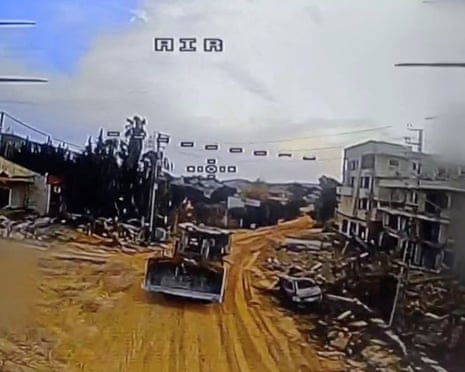 Screengrab from a video released by Hezbollah that claims to show the moment before an FPV drone attacks an Israeli bulldozer in Bint Jbeil, Lebanon. Photograph: Hezbollah Military Media/Reuters
theguardian.com
Screengrab from a video released by Hezbollah that claims to show the moment before an FPV drone attacks an Israeli bulldozer in Bint Jbeil, Lebanon. Photograph: Hezbollah Military Media/Reuters
theguardian.com
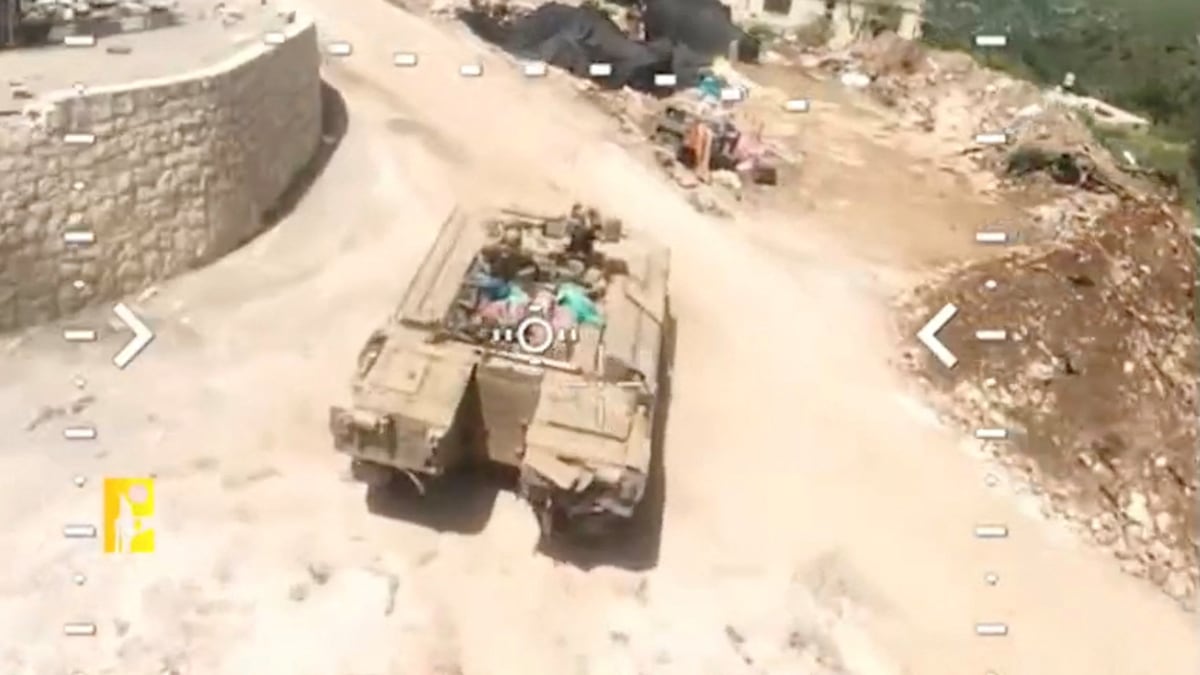
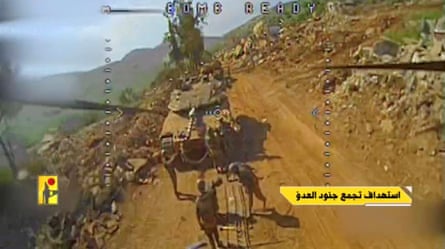 A screengrab from a video released by Hezbollah, which says it shows an Israeli tank and soldiers moments before being hit by an FPV drone in Taybeh, Lebanon. Photograph: Hezbollah military media/Reuters
theguardian.com
A screengrab from a video released by Hezbollah, which says it shows an Israeli tank and soldiers moments before being hit by an FPV drone in Taybeh, Lebanon. Photograph: Hezbollah military media/Reuters
theguardian.com
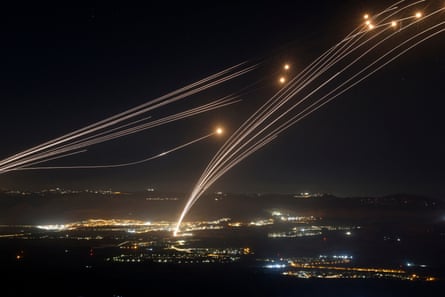 Hezbollah rockets fired from southern Lebanon are intercepted by the Iron Dome defence system over northern Israel during cross-border clashes in August 2024. Photograph: Jalaa Marey/AFP/Getty Images
theguardian.com
Hezbollah rockets fired from southern Lebanon are intercepted by the Iron Dome defence system over northern Israel during cross-border clashes in August 2024. Photograph: Jalaa Marey/AFP/Getty Images
theguardian.com
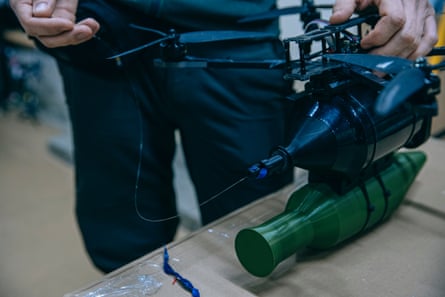 A fibre optic drone sample shown at a secret workshop of the 429th Achilles separate unmanned aerial systems regiment in Ukraine. Photograph: Julia Kochetova/The Guardian
theguardian.com
A fibre optic drone sample shown at a secret workshop of the 429th Achilles separate unmanned aerial systems regiment in Ukraine. Photograph: Julia Kochetova/The Guardian
theguardian.com
 Fiber-optic drones, the weapon Hezbollah has adopted to attack Israel: ‘Using them is easier than playing a video game’
english.elpais.com
Fiber-optic drones, the weapon Hezbollah has adopted to attack Israel: ‘Using them is easier than playing a video game’
english.elpais.com
Hezbollah’s fibre-optic FPV drones push Israel toward costlier ground war choices, cheap 3D-printed systems evade jamming and hit troops in south Lebanon, buffer-zone assumptions collide with a $300 airframe
Footage of small drones diving into Israeli armour and earthmovers in south Lebanon has become routine enough to change how both sides price the war. The Guardian reports Hezbollah has made fibre‑optic first‑person‑view (FPV) drones a central weapon in its guerrilla campaign against Israel’s occupation of parts of south Lebanon, releasing video it says shows strikes on an Israeli bulldozer in Bint Jbeil and a tank position in Taybeh. El País reports Israel still lacks a definitive answer to the tethered drones, which avoid the radio links that Israeli electronic-warfare systems are built to disrupt.
The technical trick is simple and industrially scalable: instead of relying on a radio signal that can be jammed, the drone remains connected to its operator by a fibre‑optic cable running kilometres behind it. According to the Guardian, the drones are produced using 3D printing and commercially available components, with a reported unit cost of roughly $300 to $400. El País describes the cable as about the thickness of dental floss. The result is a disposable precision munition that can be flown directly into a target using the live camera feed and detonated on impact.
On the battlefield, the drones are forcing a shift from intercepting rockets to protecting soldiers at close range. The Guardian recounts an incident in which three Israeli soldiers near a tank heard a drone and then saw it explode next to them, killing one and injuring others. El País, citing Israeli media, reports explosive drones accounted for most Israeli soldiers wounded in Lebanon during a recent period when a ceasefire existed “only on paper”. Both outlets describe strikes not only on military vehicles but also on troops and contractors, with El País saying the drones have caused multiple deaths and serious injuries.
The economics matter as much as the engineering. Israel’s air defences, designed to stop rockets and larger drones, are expensive systems defending against a weapon assembled from civilian parts and written off after a single hit. Hezbollah, the Guardian notes, has had to adapt after supply routes through Syria were disrupted, pushing it toward local manufacture on a smaller budget. That constraint has produced a weapon that is cheap enough to be used repeatedly and precise enough to be filmed, edited and circulated as proof of effectiveness.
Israel is responding, but the timeline is not comforting for troops on the ground. The Guardian quotes an Israeli military official saying Israel recognises the UAV threat and is developing detection and interception capabilities, and reports a senior officer has been tasked with finding a solution. El País reports the defence ministry has publicly requested proposals and that Prime Minister Benjamin Netanyahu has said he instructed the military to eliminate the FPV threat.
The drones are also reopening a basic question about the war’s geometry. The Guardian reports the new threat is forcing Israel to re-evaluate how deep any buffer zone in south Lebanon needs to be—an argument that used to be driven by the range of guided anti-tank missiles, and is now being rewritten by a cable-spooled quadcopter.
A $300 airframe is now shaping the distance at which an army believes it can safely stand.